책이 있는 정물 - Still Life with Oleanders and Books
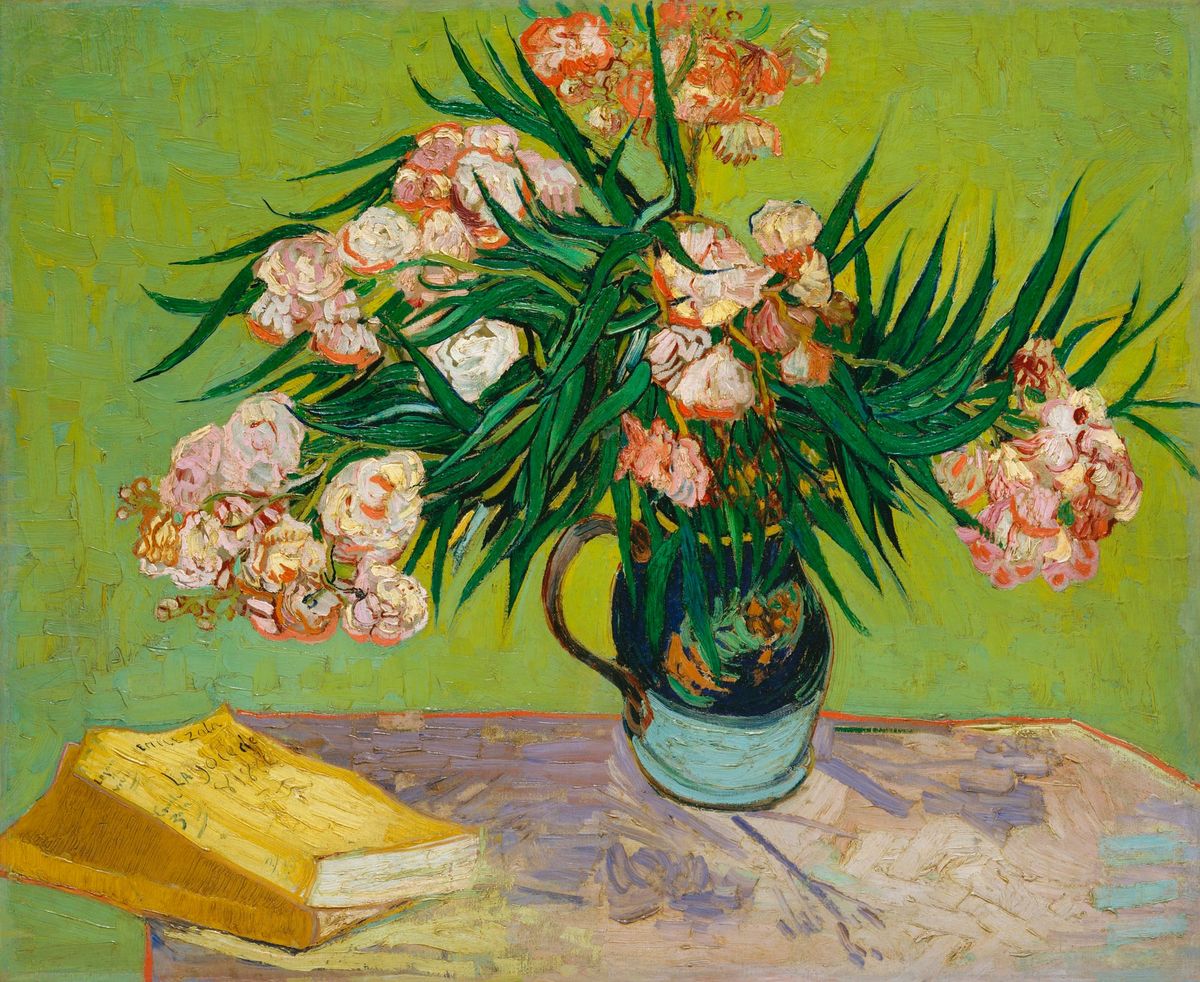
빈센트 반 고흐(Vincent van Gogh)가 남프랑스 아를(Arles)에 머물던 1888년 8월에 완성한 대표적인 유화 정물화(협죽도가 있는 정물 / Oleanders)입니다. 현재 미국 뉴욕의 메트로폴리탄 미술관(The Metropolitan Museum of Art)에 소장되어 있으며, 캔버스 위에 유채로 제작된 이 작품의 실제 사이즈는 약 60.3 × 73.7 cm입니다. 청량한 연둣빛 배경과 마요리카 도자기 화병 가득 폭발하듯 피어난 분홍빛 협죽도(올레안더) 꽃다발, 그리고 테이블 위에 놓인 에밀 졸라의 소설책을 두텁고 역동적인 임파스토(Impasto) 기법과 화려한 보색 대비로 포착해냈습니다.
고흐는 물감을 캔버스 위에 두껍게 얹어 협죽도의 뾰족하고 날렵한 잎사귀들과 탐스러운 꽃잎의 결, 화병의 매끄러운 광택, 그리고 노란 표지 소설책의 각진 양감을 조각하듯 입체적으로 구축했습니다. 배경을 가득 메운 눈부신 라임 그린 및 연둣빛 벽면은 협죽도 꽃송이들의 화사한 분홍색, 주황색과 생동감 넘치는 보색 대비를 이루며, 짙은 암록색 잎사귀들은 화면 전체에 강렬한 시각적 텐션을 부여합니다. 테이블 위에 놓인 에밀 졸라의 소설 『삶의 기쁨(La Joie de vivre)』의 노란 표지는 고흐 특유의 황금빛 색채와 지적 사유의 깊이를 더해줍니다.
1888년 늦여름, 아를의 '노란 집'에서 예술가 공동체를 꿈꾸며 정열적으로 창작에 몰두하던 고흐는, 남프랑스의 뜨거운 태양 아래 강인하게 자라나는 협죽도의 매력에 깊이 사로잡혔습니다. 고흐에게 협죽도는 끊임없이 꽃망울을 터뜨리는 대자연의 무한한 생명력이자 '삶의 환희' 그 자체였으며, 함께 배치된 문학 서적은 고통스러운 현실 속에서도 예술과 지성을 통해 삶을 긍정하고자 했던 화가 자신의 굳은 의지를 대변했습니다. 그는 동생 테오에게 보낸 편지에서 "협죽도는 영원히 새롭게 피어나며 언제나 삶의 기쁨을 노래한다"며 이 꽃에 대한 각별한 찬사를 아끼지 않았습니다.
테이블의 보랏빛 그림자와 화병의 단단한 조형미는 자연과 지성이 빚어낸 궁극의 조화를 상징합니다. 미술사에서는 고흐가 자연의 원초적 생명력과 현대 문학의 정신성을 순수 색채의 해방을 통해 완벽하게 결합시킨 아를 시기의 최고봉 정물 걸작으로 높이 평가하고 있습니다.
관람객의 무의식적인 시선은 화면 중심의 도자기 화병에서 사방으로 힘차게 뻗어나간 날렵하고 짙푸른 협죽도 잎사귀들과 그 사이로 탐스럽게 무리 지어 피어난 분홍빛 꽃송이들의 화려한 볼륨감에서 자연스럽게 출발합니다. 두터운 물감으로 빚어낸 꽃잎의 생생한 마티에르와 율동적인 선묘에 시선이 머무는 순간, 보는 이는 찰나의 침묵과 함께 프로방스 늦여름의 싱그러운 향기와 생명의 에너지 속으로 단숨에 몰입하게 됩니다.
이어 시선은 화병 우측으로 풍성하게 늘어진 꽃송이들과 잎사귀들의 유려한 궤적을 타고 내려와, 테이블 좌측 모퉁이에 단정하게 겹쳐 놓인 두 권의 노란색 소설책과 선명하게 새겨진 글씨의 윤곽에 도달합니다. 지성을 밝히는 따스한 황금빛 서책의 존재감을 마주하며, 인간의 사유와 예술이 건네는 깊은 안식과 영적인 온기를 깊이 체감하게 됩니다.
이후 시선은 연보랏빛과 상아색 붓 터치로 부드럽게 채워진 테이블 상판의 반사광을 지나, 화면 전체를 맑고 따뜻하게 감싸고 있는 은은한 연둣빛 배경을 훑은 뒤, 푸른 도자기 화병의 단단한 곡선을 타고 다시금 화려한 꽃무리로 유연하게 회귀합니다.
싱그러운 연둣빛과 화사한 분홍빛, 그리고 따스한 노란빛이 빚어내는 장엄한 색채의 순환을 따라 순환한 시선이 편안히 안착할 때, 관람객의 내면에는 복잡한 일상의 번뇌와 피로가 씻겨 내려가고, 자연과 삶이 노래하는 맑은 환희와 함께 흔들리지 않는 깊은 심리적 안도감이 가득 차오르게 됩니다.
Still Life with Oleanders and Books
Painted by Vincent van Gogh in August 1888 during his prolific residency at the Yellow House in Arles, France, this celebrated still life is preserved in the permanent collection of The Metropolitan Museum of Art in New York. Executed in oil on canvas, the actual size of the work is approximately 60.3 × 73.7 cm. Capturing a dynamic, sprawling bouquet of pink oleanders in an earthenware pitcher set alongside French paperback novels, the composition orchestrates pure complementary contrasts, dense tactile impasto, and radiant light into an ecstatic celebration of life and intellect.
Van Gogh applied unmixed paint with sculptural vitality, carving out the sharp, radiating blades of the oleander foliage, the dense clusters of creamy pink blossoms, and the structured volumes of the books on the tabletop. The vibrant chartreuse-green background establishes an intense chromatic vibration against the rose-pink petals and the deep viridian leaves, while the majolica jug with its dark blue and turquoise glaze firmly anchors the organic explosion. The inclusion of Émile Zola’s novel La Joie de vivre (The Joy of Living) in its iconic yellow cover introduces a resonant literary and philosophical dimension to the visual feast.
During the late summer of 1888, while preparing his studio for the arrival of Paul Gauguin, Van Gogh became deeply inspired by the resilient oleanders flowering profusely throughout Arles. To him, the oleander—a plant that produces fresh blooms continuously despite intense Mediterranean heat—symbolized indefatigable vitality, emotional rebirth, and the sheer joy of living. By juxtaposing this exuberant natural force with modern literature, Van Gogh asserted that human intellect and the raw beauty of nature are twin pillars of spiritual consolation and creative survival.
Art historians celebrate this composition as one of the undisputed summits of Van Gogh's Arles period, demonstrating his mastery in transforming a domestic tabletop arrangement into a monumental anthem of Post-Impressionist color theory and personal resilience.
A viewer's subconscious gaze is intuitively anchored first by the dynamic, central mass of blooming pink oleanders, whose sharp green leaves fan outward like radiant sunbeams. Lingering upon the thick, layered impasto sculpting the delicate petals and arching stems, the observer is drawn into an immediate atmosphere of summertime abundance, floral fragrance, and emotional stillness.
The gaze is then carried downward past the dark, grounded ceramic jug toward the lower left corner, arriving at the pair of yellow-covered novels resting on the lilac-tinted table. Encountering the tactile, geometric forms of the books and their evocative title, the viewer experiences a reassuring sense of intellectual companionship, purpose, and domestic peace.
The eye continues upward across the luminous pale green backdrop, taking in the sweeping rhythmic brushstrokes before returning smoothly to the vibrant blossoms above.
Completing this visual and psychological circulation, the observer feels a profound release of modern tension. The joyful harmony of natural vitality and intellectual reflection leaves the viewer restored with a lasting sense of inner clarity, emotional renewal, and enduring psychological peace.
본 리뷰에서 작품을 제외한 컨텐츠의 저작권은 팔렛트제주에 있습니다.
"퍼블릭도메인 고전명화"를 제외한 모든 창작 콘텐츠는 저작권법 제4조 및 제10조에 의거하여 보호됩니다. 무단 도용시 저작권법 제136조(벌칙)에 의거, 당사의 사전 서면 승인 없는 저작권 침해 행위를 금지합니다.