붉은 노을빛 배경에 만개한 여름의 향연, 해바라기와 장미가 있는 정물 Still Life with Sunflowers and Roses
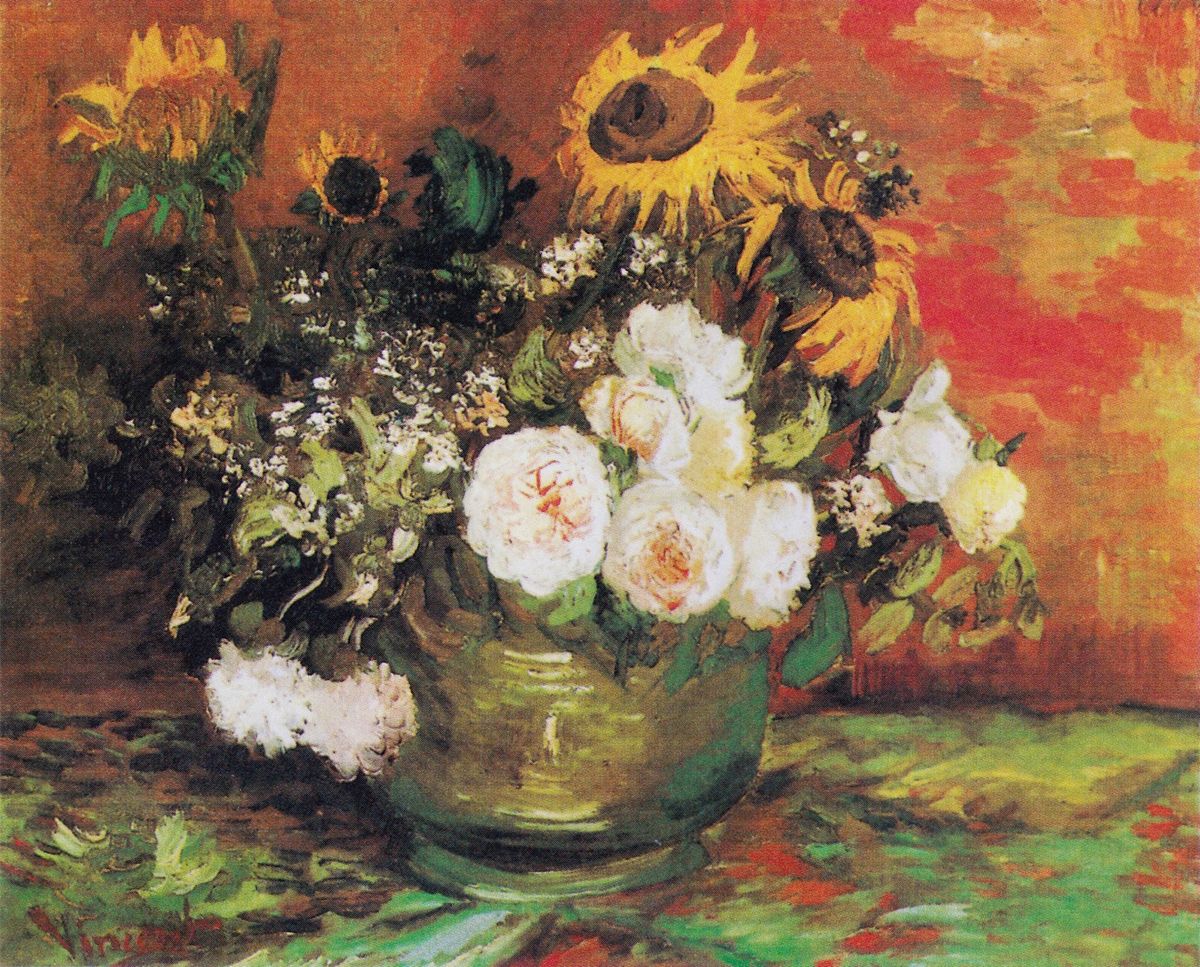
후기 인상주의의 거장 빈센트 반 고흐(Vincent van Gogh, 1853–1890)가 파리 체류 시절인 1886년 여름에 완성한 유화 《해바라기와 장미가 있는 정물(Still Life with Sunflowers and Roses, 또는 해바라기와 다른 꽃들이 있는 화병)》은 50.0 cm × 61.0 cm 크기의 캔버스에 유채로 그린 대표작으로, 현재 독일 만하임 시립미술관(Kunsthalle Mannheim)에 영구 소장되어 있습니다.
파리의 색채 세례 속에서 피어난 해바라기 탐구의 서막
1886년 봄, 네덜란드의 어둡고 무거운 흙빛 화풍을 뒤로하고 파리에 도착한 고흐는 인상파 화가들과 교류하며 강렬한 빛과 원색의 상호작용에 눈을 떴습니다. 그는 팔레트를 밝히고 보색의 조화를 체득하기 위해 계절마다 다양한 꽃 정물화 연작에 몰두했습니다.
이 작품은 고흐가 훗날 자신의 예술적 분신이자 상징으로 삼게 되는 '해바라기'를 초기 파리 시절에 어떻게 다루었는지를 보여주는 매우 귀중한 연결고리입니다. 그는 화려하게 만개한 노란 해바라기와 순백의 장미, 그리고 섬세한 안개꽃을 청동빛 화병에 풍성하게 꽂아 넣었습니다. 배경에는 활활 타오르는 듯한 붉은 주황빛 터치를 대담하게 깔고, 테이블 위에는 보색인 에메랄드 그린과 옥색을 배치하여 캔버스 전체가 뜨거운 여름날의 빛과 열기를 뿜어내도록 연출했습니다.
무의식 속 시선의 공간 확장과 감각적 몰입
감상자의 시선은 화폭의 중심에서 은은하고 탐스럽게 빛나는 순백의 장미 꽃송이들로 가장 먼저 이끌립니다. 부드러운 상아색과 연분홍빛 임파스토 터치로 빚어낸 장미의 풍성한 질감은 보는 이의 무의식 속에 포근한 촉각적 안정감을 선사합니다.
이어 시선은 줄기를 타고 위로 솟아올라, 화폭 상단에서 왕관처럼 고개를 들고 있는 짙은 황금빛 해바라기의 역동적인 꽃잎들로 자연스럽게 이동합니다. 그 후 시선은 배경의 타오르는 듯한 붉은빛 노을의 잔영을 스쳐, 화면 하단의 청록빛 테이블과 묵직한 화병의 둥근 곡선으로 완만하게 순환합니다. 붉은 배경의 열기와 푸른 테이블의 서늘함, 그리고 노란 해바라기와 흰 장미가 이루는 다층적 보색 대비 속에서, 관람자는 의식하지 못하는 사이 계절의 절정이 전하는 눈부신 생명력과 화가의 벅찬 창작열에 깊이 동화됩니다.
인상주의의 흡수와 독자적 조형 언어의 확립, 미술사적 평가
미술계는 이 작품을 반 고흐가 네덜란드 사실주의의 굴레를 완전히 벗어던지고 파리의 아방가르드 색채 이론을 자신만의 방식으로 훌륭하게 소화해 낸 기념비적인 초기 걸작으로 평가합니다.
단순한 꽃의 형태 묘사에 머무르지 않고, 두터운 물감의 물질감과 강렬한 보색 대비를 통해 대상이 지닌 내재적 에너지를 시각화했습니다. 파리 시절의 치열한 색채 실험을 거쳐 훗날 남프랑스 아를에서 탄생할 불멸의 '해바라기' 연작의 토대를 닦은 이 정물화는, 반 고흐가 근대 회화의 위대한 거장으로 도약하는 찬란한 출발점을 증명하고 있습니다.
A Summer Symphony Against a Crimson Sunset, Still Life with Sunflowers and Roses
Painted in the summer of 1886 during his transformative early Paris period by Vincent van Gogh (1853–1890), Still Life with Sunflowers and Roses (also known as Vase with Sunflowers and Other Flowers) is an oil on canvas measuring 50.0 cm × 61.0 cm (19.7 in × 24.0 in), preserved in the permanent collection of the Kunsthalle Mannheim in Mannheim, Germany.
The Parisian Awakening: Early Sunflower Studies and Chromatic Vitality
Upon arriving in Paris in the spring of 1886, Van Gogh confronted the dazzling brilliance of Impressionist palettes, prompting an urgent reinvention of his somber Dutch technique. To master the laws of simultaneous contrast and brighten his brushwork, he threw himself into painting dozens of vibrant floral arrangements throughout the summer.
This canvas represents a pivotal threshold in his artistic trajectory, marking his earliest systematic exploration of the sunflower—a motif that would soon become his ultimate spiritual emblem in Arles. Vincent gathered mature golden sunflowers alongside delicate white roses and sprays of wildflowers, arranging them within a lustrous bronze bowl. By setting the bouquet against an incandescent field of fiery red and ochre, balanced by the cool jade tones of the tablecloth below, he transformed a conventional tabletop still life into a radiant celebration of pure light and heat.
Psychological Trajectory of the Gaze and Sensory Immersion
The observer’s subconscious gaze is immediately welcomed by the luminous cluster of full-bloomed white roses nestled at the visual center. Rendered in thick, tactile layers of ivory and pale blush, these soft blossoms instill an instinctive sensation of textural elegance and emotional tranquility.
From this delicate core, visual perception ascends along the fibrous stems toward the crowning golden sunflowers radiating across the upper quadrant with bristling vitality. The eye then disperses into the background, swept along the dynamic red-orange brushwork before settling upon the grounded bronze vessel and the cool viridian table surface. Navigating the dramatic friction between warm crimson flames and refreshing aquatic greens, the viewer subconsciously internalizes the fertile abundance of midsummer and the artist's boundless creative awakening.
Textural Freedom and the Prelude to Modernism: Critical Legacy
Art historians celebrate this 1886 still life as an indispensable milestone, capturing the exact moment Van Gogh synthesized Parisian avant-garde color science into his evolving expressive aesthetic.
Moving beyond mere botanical replication, Vincent utilized dense impasto and complementary chromatic tension to reveal the underlying pulse of the natural world. Directly foreshadowing the iconic Sunflowers of his Provençal period, this masterwork endures as a luminous declaration of artistic rebirth, marking the beginning of his journey toward becoming a singular titan of modern art.
Copyright © Palette Jeju. All rights reserved. Unauthorized reproduction or redistribution is strictly prohibited.본 컨텐트의 저작권은 팔렛트제주에 있습니다. 허가없는 무단전제를 금지합니다.