부지발의 가옥들, 가을 (Maisons à Bougival, automne, 1870)
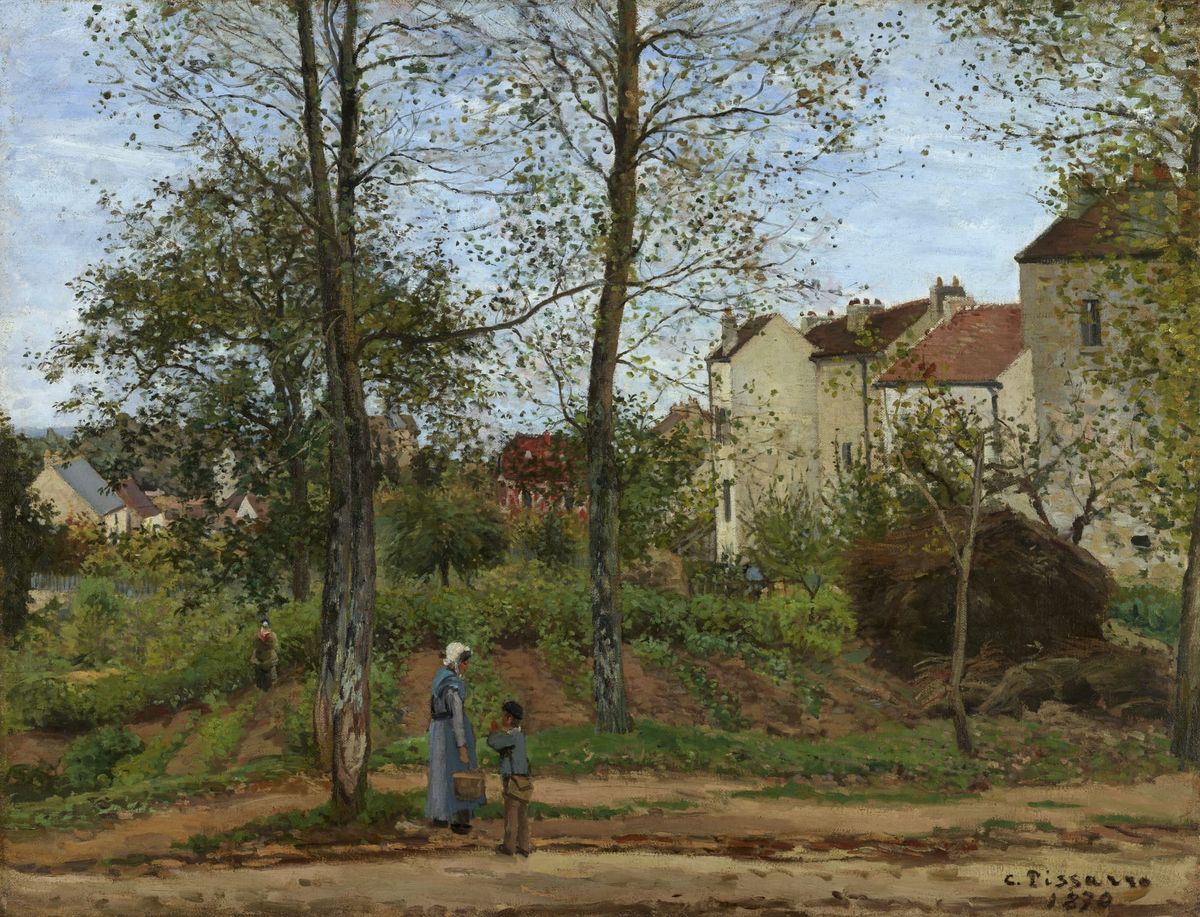
1870년 가을 보불전쟁의 포화가 파리 근교로 들이닥치기 직전, 카미유 피사로는 이웃 마을 부지발의 한적한 길목에서 맑은 가을 햇살과 대지의 풍요로운 정취를 화폭에 담았습니다.
당시 프로이센 군대의 침공으로 인해 피사로는 가족과 함께 영국 런던으로 황급히 피란을 떠나야 했고, 그 여파로 루브시엔 작업실에 보관되어 있던 수많은 초기 작품들이 훼손되거나 유실되는 참화를 겪었습니다. 그 극적인 격변기 직전에 완성되어 오늘날 미국 로스앤젤레스 J. 폴 게티 미술관에 보존된 이 귀중한 원작은 가로 116.2cm, 세로 88.9cm에 이르는 웅장한 크기의 캔버스에 유채로 완성된 대작으로, 피사로 초기 풍경화 중에서도 가장 뛰어난 완성도와 규모를 자랑하는 기념비적인 작품입니다.
관람자의 시각 인지 체계는 화면 좌측 하단의 흙길 가장자리에서 하얀 보닛과 푸른 앞치마를 두른 여인과 그 곁에 서서 대화를 나누는 어린 소년의 형태감에 가장 먼저 닻을 내립니다. 모자(母子)의 따뜻한 인물 실루엣과 황토빛 흙길이 형성하는 안정적인 색채 대비는 시각 피질의 중심와를 즉각 포획하며 화면의 조형적 구심점을 확립합니다.
이어서 시선은 두 인물 바로 뒤편에 우람하게 솟아오른 키 큰 가로수들의 수직 기둥을 타고 상승하여, 잎사귀 사이로 드러난 높고 푸른 가을 하늘과 은은한 구름의 대기 질감을 확인하는 도약 안구 운동을 진행합니다.
하늘을 가로지른 시선은 화면 우측 중경에 견고한 블록처럼 서 있는 밝은 석조 가옥들의 기하학적 벽면과 붉은 기와지붕으로 하강한 뒤, 완만하게 경사진 텃밭과 울창한 수풀의 결을 거쳐 화면 좌측 원경의 나지막한 마을 지붕들로 자연스럽게 확장됩니다.
가을바람에 살랑이는 나뭇잎의 질감과 부드러운 대기광이 망막 위에서 하나의 완성된 공간으로 통합되는 순간, 관조자는 번잡한 일상의 긴장을 내려놓고 평화로운 시골길의 포근한 온기 속에 머무는 듯한 깊은 심리적 안도감과 내면의 평온을 체험하게 됩니다.
이 시기 피사로는 부지발에 거주하던 클로드 모네와 르누아르 등과 교류하며 자연의 미묘한 광선 변화를 캔버스 위에 어떻게 고정할 것인가를 치열하게 모색하고 있었습니다. 그는 전통 회화의 인위적인 명암법 대신, 햇살을 머금은 하얀 벽면과 대지의 흙빛을 투명하고 섬세한 색채의 조화로 엮어내며 캔버스 전체에 생동하는 생명력을 부여했습니다.
건축물의 단단한 입체감과 자연의 유기적인 호흡을 결합한 피사로의 이러한 조형 감각은, 훗날 폴 세잔이 입체적인 공간 구축을 탐구하는 데 결정적인 회화적 길잡이가 되었습니다.
풍요로운 계절의 온기와 인간 삶의 소박한 호흡을 웅장한 스케일과 탁월한 균형감으로 직조해 낸 피사로의 이 부지발 가을 풍경은, 현대 미술사에서 바르비종파의 묵직한 사실주의를 계승하면서도 인상주의의 찬란한 빛의 시대를 활짝 열어젖힌 독보적인 명작으로 확고하게 평가받고 있습니다.
Houses at Bougival, Autumn (Maisons à Bougival, automne, 1870)
In the autumn of 1870, on the very eve of the Franco-Prussian War, Camille Pissarro captured the golden, crystalline atmosphere of the neighboring village of Bougival.
As Prussian forces rapidly advanced, the master was forced to flee with his family to London, leaving behind his Louveciennes studio where the vast majority of his formative output was tragically vandalized or lost. Miraculously preserved and now housed in the J. Paul Getty Museum, this exceptional horizontal oil on canvas, measuring an impressive 88.9 by 116.2 cm, represents one of the largest and most ambitious masterworks from Pissarro's critical early period, epitomizing his command of atmospheric light and architectural stability.
The observer’s perceptual framework instantly anchors upon the peasant woman wearing a crisp white bonnet and azure apron conversing with a young boy along the lower-left road. The gentle tonal harmony of this domestic pairing against the sun-baked earth stimulates the fovea, establishing an intuitive and comforting human center for visual navigation.
From this grounded anchor, the ocular trajectory ascends through the monumental vertical columns of the towering roadside trees, exploring the delicate foliage etched against the sweeping expanse of the pale blue autumn sky.
Tracing the luminous daylight above, the gaze descends toward the right midground, sweeping across the pale stone facades and terracotta roofs of the village houses before gliding across the terraced vegetable plots and distant roofs nestled within the valley on the left.
As the physical permanence of the stone masonry and the gentle breath of the autumn breeze integrate into a cohesive visual rhythm within the visual cortex, active scanning dissolves into profound contemplative stillness, attuned to the timeless peace of the French countryside.
During this fertile phase, Pissarro maintained an intensive working dialogue with Claude Monet in Bougival, pioneering the technique of rendering sunlit surfaces and ambient shadows through luminous, broken color rather than muddy salon glazes.
His rigorous interlocking of solid architectural planes with organic landscape textures profoundly inspired Paul Cézanne, who frequently acknowledged Pissarro's foundational guidance in constructing pictorial space.
Masterfully harmonizing structural weight with delicate atmospheric poetry, Pissarro's panoramic autumn view of Bougival remains celebrated across art history as an enduring cornerstone in the birth of modern landscape painting.
본 콘텐츠의 저작권은 저작권자에게 있으며, 무단 전재 및 재배포를 금합니다.