빈 술잔을 들여다보는 사내 The Empty Tankard
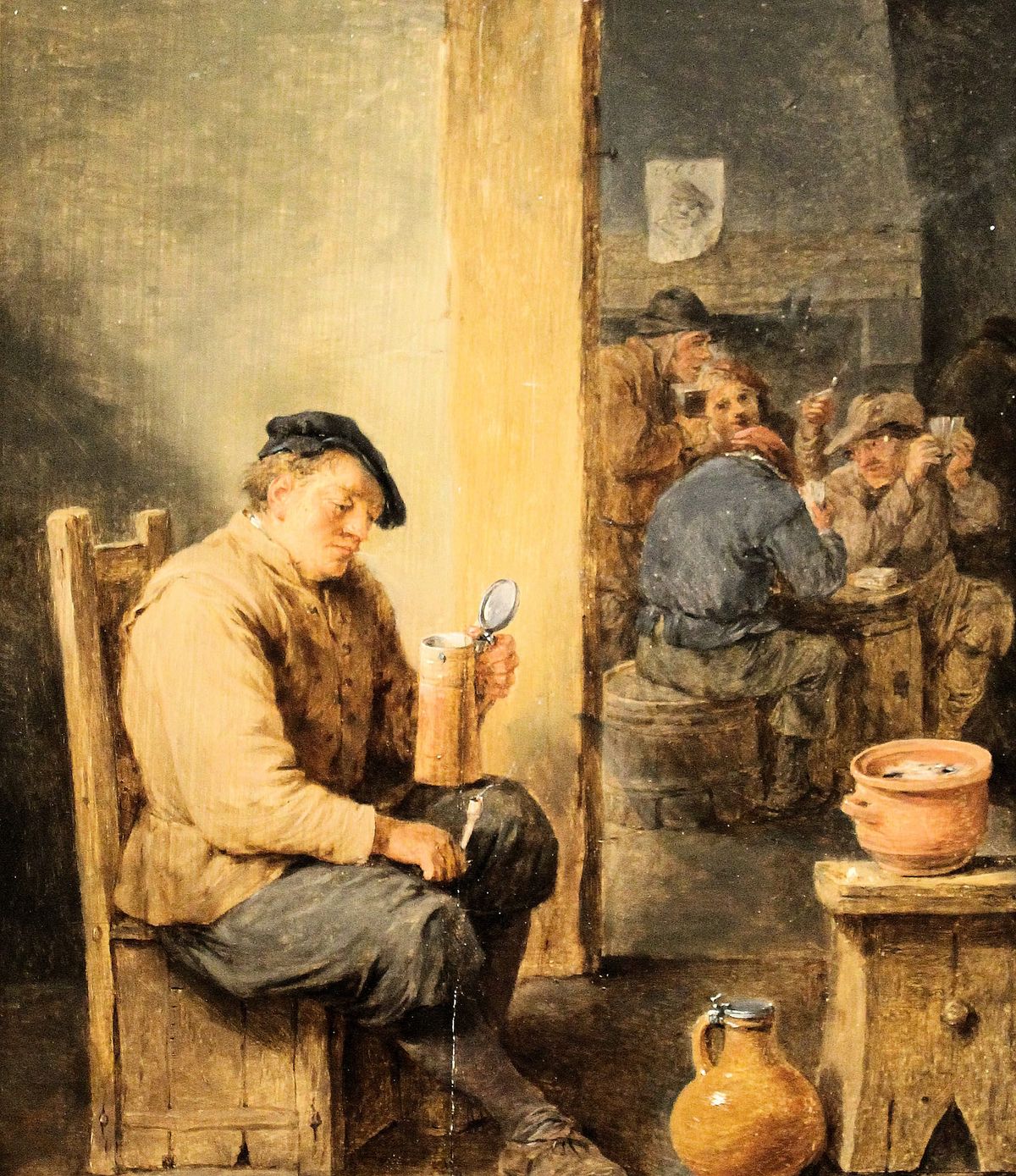
17세기 플랑드르 바로크 풍속화 및 선술집 실내화의 거장 소 다비드 테니어르스(David Teniers le Jeune, 1610–1690)가 1640년대 중반 안트베르펜 전성기 시절에 완성한 기념비적 실내 풍속 유화 빈 술잔을 들여다보는 사내(The Empty Tankard, 또는 주막에서 술잔을 비운 사내, 덴마크어: Det tomme krus, 프랑스어: Le pot vide, 소장품 번호: 0049NMK)는 38.0 cm × 32.5 cm 크기의 아담한 세로형 패널(목판)에 유채로 그린 대표적인 북유럽 주점 풍속화 최고 걸작입니다.
유럽 유수의 명문 귀족 컬렉션을 거쳐 현재 덴마크 니바의 유서 깊은 니바고르 컬렉션 미술관(Nivaagaards Malerisamling, Nivå)에 영구 소장되어 보존되어 오고 있습니다.
일상의 고단함과 텅 빈 잔이 주는 허무를 향한 화가의 고뇌
1640년대 플랑드르 화단을 이끌던 삼십 대의 테니어르스는, 주점의 거친 폭력이나 술주정 대신 술자리가 끝난 뒤 찾아오는 인간의 쓸쓸한 내면과 고독한 순간을 화폭에 담고자 깊이 고민했습니다.
화가는 주머니 속 마지막 동전까지 털어 맥주 한 잔을 마신 뒤, 뚜껑을 열고 바닥난 맥주잔을 멍하니 들여다보는 평범한 노동자의 쓸쓸한 얼굴을 통해, 찰나의 쾌락 뒤에 밀려오는 인생의 덧없음(바니타스)과 가난한 서민의 고단한 현실을 어떻게 맑고 차분한 은빛 대기(Silvery manner) 속에 담아낼지 치열하게 번민했습니다.
당시 북유럽 풍속화에서 바닥을 드러낸 주석 뚜껑 달린 맥주잔은 물질적 소비의 유한함과 인생의 덧없음을 경고하는 도덕적 알레고리인 동시에, 일상의 고단함을 달래던 소박한 휴식의 끝을 의미했습니다.
화가는 밝은 빛이 들어오는 주막 입구 문간에서, 묵직한 나무 의자에 앉아 빈 맥주잔을 들여다보는 사내와 뒤편 안쪽 방에서 카드놀이를 즐기는 이웃들의 대조적인 순간을 화폭에 담았습니다.
화면 왼쪽 전면에는 검은 빵모자를 삐딱하게 쓰고 황토색 외투를 입은 사내가 나무 의자에 걸터앉아, 뚜껑이 달린 도자기 맥주잔을 높이 들어 바닥을 물끄러미 내려다보고 있습니다.
그의 다른 손에는 방금 피우다 만 하얀 점토 파이프가 쥐여 있고, 주머니를 다 털어버린 듯한 그의 쓸쓸한 눈빛과 살짝 벌어진 입술은 깊은 생각에 잠겨 있습니다.
화면 오른쪽 밝은 안쪽 방에서는 푸른 옷을 입은 사내가 통나무 의자에 앉아 카드놀이에 몰두하고 있고, 벽난로 앞의 동료들은 맥주잔을 부딪치며 웃고 떠들고 있습니다.
바닥에 놓인 윤기 흐르는 황갈색 도자기 주전자와 나무 스툴 위의 따뜻한 옹기 냄비, 그리고 벽에 붙은 희미한 드로잉 판화는, 화기애애한 술자리 뒤편에 남겨진 개인의 고독한 침묵을 손에 잡힐 듯 생생하게 웅변합니다.
들려 올린 맥주잔과 사내의 쓸쓸한 눈빛에서 카드놀이 패거리와 황금빛 술병으로, 시선의 심리적 여정
그림을 마주하는 순간 관람객의 무의식적 시선은 화면 왼쪽 전면에서 부드러운 햇살을 받아 환하게 빛나는 사내의 황토색 외투와 그가 들어 올린 원통형 맥주잔의 동그란 뚜껑으로 가장 먼저 빨려 들어갑니다.
마지막 한 방울까지 비워낸 잔을 뚫어지게 바라보며 넋을 놓고 있는 사내의 처연한 눈빛과 굳게 다문 입술은 보는 이에게 깊은 시각적 몰입감과 함께 가슴 한구석이 서늘해지는 허무감을 선사합니다.
이어 시선은 사내의 손에 들린 하얀 점토 담배 파이프와 묵직한 나무 의자의 거친 결을 지나, 화면 오른쪽 안쪽 방에서 시끌벅적하게 카드놀이를 벌이는 세 사내의 역동적인 모습으로 이동합니다.
한 장의 카드에 일희일비하며 술잔을 기울이는 동료들의 활기찬 웃음소리를 확인하는 순간, 관람객은 맥주 냄새와 담배 연기가 자욱한 17세기 플랑드르 선술집 한복판 속으로 온몸이 빨려 들어가게 됩니다.
마지막으로 시선은 안쪽 방 벽난로 벽에 붙어 있는 익살스러운 얼굴 드로잉 판화를 지나, 화면 오른쪽 아래 나무 스툴 위에 놓인 붉은 옹기 냄비와 바닥에서 은은하게 반짝이는 황갈색 도자기 술병의 매끄러운 표면에 멈춥니다.
전면 사내의 고독한 정적과 후면 무리의 떠들썩한 활기가 빚어내는 완벽한 심리적 대조를 마주하며, 관람객은 삶의 환희 뒤에 숨겨진 인간 본연의 외로움과 거장 테니어르스가 건네는 묵직한 서민적 위로를 가슴 깊이 마주하게 됩니다.
17세기 플랑드르 심리 풍속화의 정점과 조형미, 미술계의 평가
미술계는 니바고르 컬렉션 미술관의 빈 술잔을 들여다보는 사내를 테니어르스가 인물의 깊은 내면 심리 묘사와 정밀한 실내 공간 구성을 가장 완벽한 기량으로 결합해 완성한 대표적인 소형 목판 명작으로 평가합니다.
단순한 음주 장면을 넘어 도덕적 성찰과 인간적 페이소스를 완벽한 명암의 대비 속에 배치했을 뿐만 아니라, 도자기 술병의 매끄러운 유약 광택, 주석 뚜껑의 차가운 금속성, 거친 나무 의자의 질감, 실내를 감싸는 은빛 명암의 투명한 공기감을 극도로 섬세한 북유럽 사실주의 유화 기법으로 완벽하게 구현했기 때문입니다.
평범한 일상의 가장 쓸쓸하고 진솔한 순간을 격조 높은 시각 서정시로 승화시킨 테니어르스의 이 걸작 화폭은, 오늘날까지도 전 세계 수많은 감상자들에게 깊은 감탄과 잊을 수 없는 시각적 여운을 전해주는 불멸의 명작으로 손꼽히고 있습니다.
The Empty Tankard
Painted in the mid-1640s in Antwerp by the master of Flemish Baroque genre and tavern interior painting David Teniers the Younger (1610–1690), The Empty Tankard (Danish: Det tomme krus, French: Le pot vide, Inventory No. 0049NMK) is an intimate interior genre masterpiece in oil on panel measuring 38.0 cm × 32.5 cm (15.0 in × 12.8 in).
Preserved across distinguished European aristocratic collections, it is housed today in the celebrated permanent collection of the Nivaagaard Collection (Nivaagaards Malerisamling) in Nivå, Denmark.
Beyond Boisterous Taverns, the Melancholy of Vanitas, and Solitary Reflection
During the mid-1640s in Antwerp, David Teniers the Younger refined his celebrated ability to capture tavern interiors, deliberately turning his focus away from violent brawls toward the quiet psychological solitude that follows tavern revelry.
The master meditated deeply on the subtle pathos of a working-class peasant gazing into his depleted beer stein after spending his last coins, exploring how the empty vessel served as a poignant vanitas symbol on the fleeting nature of pleasure and the quiet reality of peasant life beneath a refined silvery chiaroscuro.
In Northern Netherlandish iconography, an empty pewter-lidded tankard warned against squandered resources and the transience of earthly joy, while reflecting the quiet dignity of a solitary worker lost in contemplation.
Teniers staged the scene at the luminous threshold between the front room and the tavern's inner drinking parlor.
In the left foreground, a seated peasant in a dark beret and warm ochre doublet rests on a heavy timber chair, holding up a cylindrical ceramic mug and lifting its pewter lid to peer wistfully into the bottom.
In his other hand rests a white clay tobacco pipe, his melancholic gaze and parted lips revealing deep introspection.
In the sunlit chamber beyond the doorframe, companions in blue coats sit around a barrel playing cards and enjoying drinks by the smoking fireplace, while across the foreground floor rests a glazed stoneware flagon and a terracotta pot upon a wooden stool, celebrating the authentic textures, domestic warmth, and unvarnished humanity of 17th-century Flemish tavern life.
Subconscious Trajectory of the Gaze: From the Raised Pewter Lid to the Card Players
The observer's subconscious gaze is immediately magnetized by the central-left foreground, drawn to the luminous daylight striking the peasant’s ochre sleeve, his contemplative facial features, and the circular pewter lid of the raised tankard.
His still posture, heavy woolen garments, and longing gaze into the empty cup establish an instant focal point of psychological vulnerability, rustic realism, and narrative stillness.
The visual path then shifts across the doorway into the brightly lit background parlor, lingering over the active group of card players huddled around the overturned cask.
Taking in their animated gestures, raised glasses, and the lively rhythm of the card game, the viewer directly experiences the authentic, sensory contrast between collective festivity and private solitude.
Finally, the visual trajectory descends past the printed drawing pinned to the chimney mantle toward the lower-right foreground, resting upon the terracotta bowl on the wooden bench and the lustrous ochre glaze of the stoneware flagon on the floor.
Observing the harmonious equilibrium between foreground solitude, deep tavern perspective, and precise Netherlandish draftsmanship, the spectator perceives the timeless nobility of simple introspection and the profound aesthetic brilliance Teniers embedded within the panel.
The Monument of Flemish Tavern Psychology: Critical Legacy
Art historians revere the Nivaagaard Empty Tankard as an exemplary masterpiece of Teniers’s cabinet style, illustrating his consummate ability to unite still-life precision, psychological depth, and atmospheric lighting on an intimate panel.
By orchestrating delicate textural contrasts between polished ceramic glazes, dull pewter lids, coarse woolen jackets, splintered timber chairs, and glowing tavern dust within a unified spatial enclosure, Teniers elevated a quiet pause into an exquisite aesthetic treatise on human nature.
This precious historical panel endures as an inspiring testament to the master's creative fortitude, celebrating the quiet poetry of everyday existence and the transformative grace of living art.
본 컨텐트의 저작권은 팔렛트제주에 있습니다. 허가없는 무단전제를 금지합니다.
Copyright © Palette Jeju. All rights reserved. Unauthorized reproduction or redistribution is strictly prohibited.