비행 기계 연구 (Design for a Flying Machine / Ornithopter)
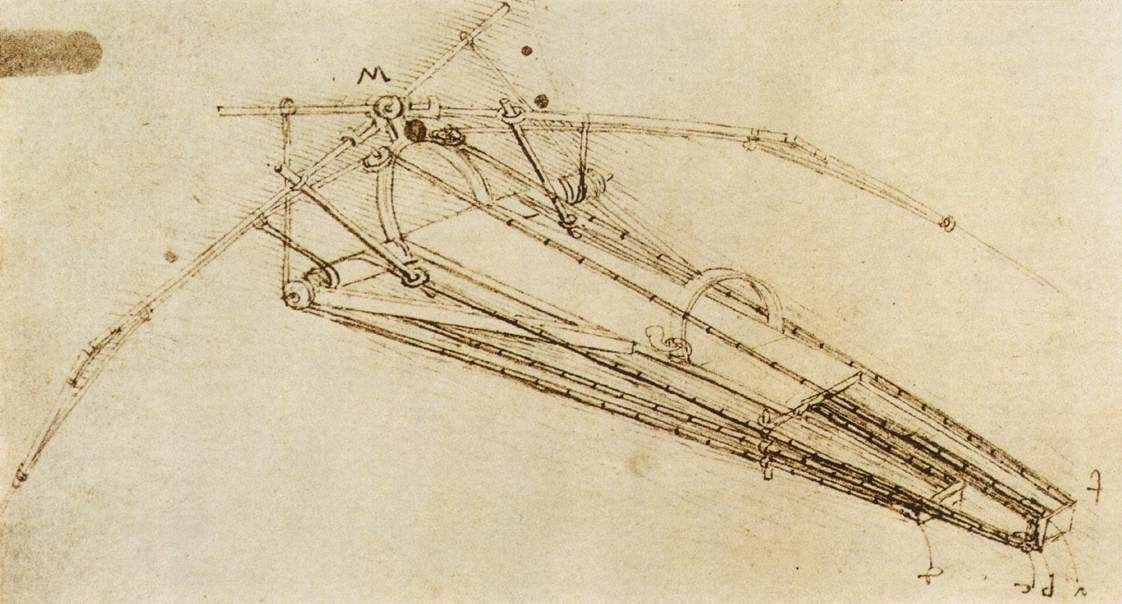
이 작품은 르네상스 시기 천재 거장 레오나르도 다 빈치(Leonardo da Vinci, 1452–1519)가 1488–1490년경 완성한 공학 드로잉 명작 <비행 기계 연구 (Design for a Flying Machine / Flying Machine Study)>로, 실제 규격은 가로 23.5cm, 세로 13.5cm 크기이며 현재 프랑스 파리의 프랑스 한림원(Institut de France, Paris / Codex B)에 소장되어 있습니다. 종이 위에 펜과 잉크로 비행에 대한 인류의 고대 열망을 공학적 메커니즘으로 구현한 레오나르도의 대표적인 과학적 스케치입니다.
미술사학계 및 과학사학계의 분석에 따르면, 작품 속 구조물은 조류의 날개짓과 인간의 근력을 결합한 '오니솝터(Ornithopter)' 메커니즘을 보여줍니다. 중앙의 보트형 침대 구조는 조종사가 엎드려 들어가는 공간이며, 연동된 도르래와 레버, 페달 장치는 인간의 팔다리 힘을 효율적으로 전달하여 거대한 인공 날개를 움직이도록 설계되었습니다. 레오나르도는 자연에 존재하는 새와 박쥐의 비행 원리를 관찰하고 이를 기계적 도면으로 정교하게 시각화함으로써, 예술적 섬세함과 공학적 통찰이 완벽하게 결합된 르네상스 과학 회화의 정수를 제시합니다.
이 화폭에는 인류 항공 역사에 직결된 대담한 과학적 비하인드 스토리와 평가가 담겨 있습니다. 레오나르도는 밀라노 공작 루도비코 스포르차의 군사 및 기계 공학자로 활동하던 시절, 수많은 비행 기계 도면을 노트(Codex B)에 기록했습니다. 당시 과학기술로는 인간의 근력이 기계 중량을 감당할 수 없었기에 실제 비행으로 이어지지는 못했으나, 이 구조는 400년 후 현대 글라이더와 비행기의 탄생에 직간접적인 아이디어를 제공했습니다. 후대 학자들은 이 드로잉을 단순한 예술 작품을 넘어 르네상스 시대의 한계를 뛰어넘은 거장의 초인적인 상상력과 과학적 탐구 정신의 정수로 높이 평가합니다.
이 그림을 가만히 바라보고 있으면 보는 이의 무의식 속에서 은은한 대각선 시선 순환 구조가 부드럽게 작동합니다. 가장 먼저 조종사가 누우게 되는 중앙의 긴 보트형 침대 틀과 도르래 도면에 시선이 머문 뒤, 상단의 복잡한 기어 및 연결 끈 라인을 따라 왼쪽의 유연하게 뻗은 날개 뼈대 구조로 이동합니다. 이후 오른쪽으로 길게 뻗어나간 반대편 날개 축의 곡선을 타고 하단의 세밀한 라벨 부호와 레버 장치로 내려와 다시 중앙의 몸체 프레임으로 되돌아오는 유연한 시선 흐름을 완성합니다. 이러한 시각적 순환 유도는 대뇌 인지 영역에서 찰나의 긴장감을 해쇄하고, 거장의 날것 그대로의 필선 속에서 깊은 내면의 평온과 안식을 선사합니다.
This masterpiece, titled Design for a Flying Machine (also known as a Flying Machine Study), was created around 1488–1490 by Renaissance genius Leonardo da Vinci (1452–1519). Measuring 23.5 cm in width by 13.5 cm in height, this detailed pen and ink drawing on paper is currently preserved in the Institut de France (Codex B) in Paris, France. Depicting an intricate mechanical apparatus designed to achieve human flight through mechanical wings, the drawing stands as a historic monument merging art and aviation engineering.
Art and science historical scholarship highlights the brilliant biomimetic mechanics embedded within the drawing. Designed as an ornithopter, the structure features a central plank-like bed where the pilot lies prone, using hand cranks, foot pedals, and a pulley system to flap the hinged wings. Leonardo closely observed the flight dynamics of birds and bats, translating organic muscle movements into rigid mechanical levers and tension ropes, demonstrating his unmatched ability to synthesize natural observations with functional engineering logic.
Fascinating historical backstories and glowing evaluations surround this iconic technical sheet. Created during Leonardo's service as a military engineer to Ludovico Sforza in Milan, this manuscript page from Codex B records his lifelong obsession with conquering the skies. Although constrained by the materials of his era and the limits of human muscle power, his visionary blueprints prefigured modern flight concepts centuries before the Wright brothers. Modern historians revere this drawing as a supreme achievement of Renaissance humanism, celebrating its profound testament to human ingenuity and boundless curiosity.
Gazing upon this intricate schematic gently awakens a subtle subconscious visual rhythm. The viewer’s eye originates at the central structural frame where the aviator rests, ascends along the complex pulley and gear assembly near the top, and glides outward along the sweeping curve of the left wing framework. The gaze then sweeps across the symmetrical right wing span, descends through the detailed lettered annotations at the bottom, and fluidly returns to the central fuselage, completing a soft, circular loop. This harmonious visual movement dissolves inner cognitive tension, inviting the mind into a quiet sanctuary of artistic wonder and serene contemplation.
본 리뷰에서 작품을 제외한 컨텐츠의 저작권은 팔렛트제주에 있습니다.
"퍼블릭도메인 고전명화"를 제외한 모든 창작 콘텐츠는 저작권법 제4조 및 제10조에 의거하여 보호됩니다. 무단 도용시 저작권법 제136조(벌칙)에 의거, 당사의 사전 서면 승인 없는 저작권 침해 행위를 금지합니다.