비 Rain
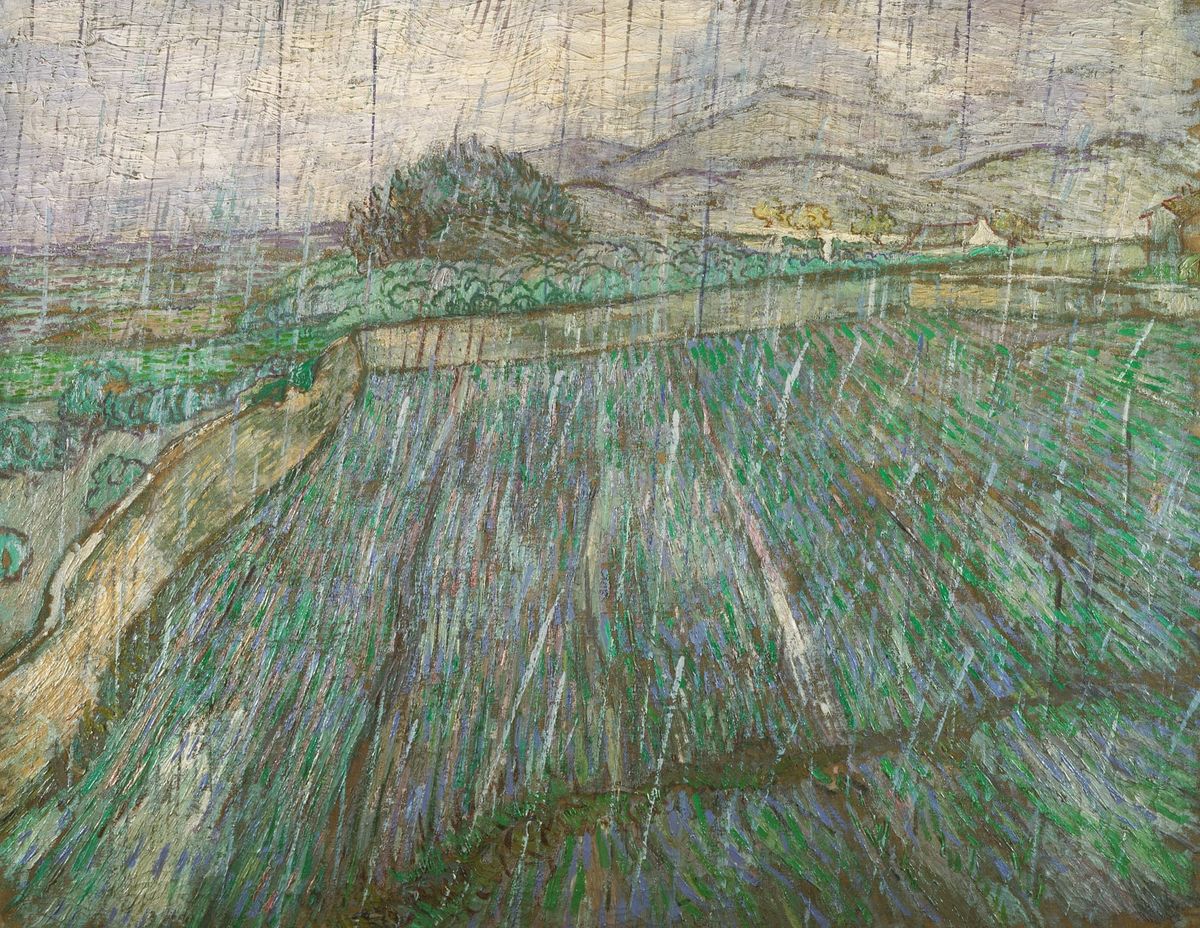
이 작품은 네덜란드의 후기 인상주의 거장 빈센트 반 고흐가 1889년 11월 프랑스 생레미드프로방스의 요양원에 머물던 시기에 제작한 유화입니다. 공식 소장품 등록번호는 F650이며 (존 홀스커 분류 기준 JH 1839), 캔버스 위에 유채로 그려진 실제 실측 규격은 73.3 x 92.4 cm입니다. 현재 이 작품은 미국 필라델피아 미술관에 공식적으로 소장되어 있으며, 헨리 플루머 맥일헤니 컬렉션을 거쳐 오늘날 전 세계 관람객들에게 깊은 인상을 전하고 있습니다.
작가의 고뇌와 창작 비하인드
생-폴-드-모솔 요양원 자발적 입원 시절, 반 고흐는 병원 창밖으로 내다보이는 울타리 쳐진 들판과 주변 풍경을 관찰하며 하루하루의 날씨 변화와 계절의 감흥을 화폭에 담는 작업에 깊이 몰두했습니다. 특히 가을비가 거세게 내리던 날, 그는 차분하게 가라앉은 초록빛과 포도빛 블루, 그리고 부드러운 보라빛이 어우러지는 가을 대지의 정경을 포착해 이 작품을 완성했습니다.
작품 전경에는 빗줄기 속에서 대각선 방향의 밭이랑들이 거칠고 역동적인 결을 이루며 화면 아래를 가득 채우고 있습니다. 중경에는 비에 젖은 언덕을 가로지르는 담장과 둥근 수풀 무더기가 자리 잡고 있으며, 화면 오른쪽 멀리 아스라이 보이는 초가집과 언덕 위의 풍경이 평온한 촌락의 정취를 더해줍니다.
배경으로는 하늘에서 쏟아지는 수많은 빗줄기들이 사선으로 길게 그어져 있으며, 먼 산맥과 흐린 회색빛 하늘이 대지를 감싸 안아 차갑고 묵직한 가을비의 대기감을 고스란히 전해줍니다.
무의식 속 시선 및 심리 흐름
관람객의 시선은 가장 먼저 화면 전체를 가로지르며 내리치는 수많은 빗줄기들과 밭이랑의 거친 붓터치로 향하며, 비 오는 날의 스산하고도 생생한 현장감에 압도당합니다. 이어지는 시선은 밭을 나누는 담장과 둥근 수풀의 중경으로 이동하여, 비바람을 고스란히 맞으며 버텨내는 대지의 묵직한 생명력을 체감하게 됩니다.
시선이 다시 멀리 겹쳐진 언덕과 회색빛 하늘의 배경으로 확장될 때, 관람객은 외부 세계와 단절된 요양원 생활 속에서 쓸쓸함과 자연의 경외감 동시에 마주했던 작가의 고독한 내면에 온전히 동화됩니다. 이 일련의 시선 이동은 단순한 풍경 묘사를 넘어, 우울한 빗속에서도 자연의 율동을 놓치지 않으려 했던 화가의 치열한 시선 속으로 깊숙이 빠져들게 만듭니다.
미술계의 평가 및 조형미
미술사학계와 평단은 본 작품을 고흐가 생레미 시기에 달성한 풍경화의 독창적 성취로 평가하며, 특히 일본 우키요에 판화에서 영감을 받아 사선으로 내리는 빗줄기를 표현한 대담한 기법을 높이 인정합니다. 캔버스 위에 거칠고 속도감 있게 얹어진 임파스토 기법은 빗방울이 내리꽂히는 대지의 질감과 흐린 대기의 입체감을 손에 잡힐 듯 생생하게 살아나게 만듭니다.
화면 전반을 지배하는 차분한 초록빛과 회색조의 톤은 궂은 날씨의 쓸쓸함을 시각적으로 완벽하게 구현하며 뛰어난 조형적 완성도를 선사합니다. 자연의 일상적인 날씨마저 자신만의 독창적인 예술 언어로 승화시킨 이 작품은, 시대를 초월해 관람객의 마음에 깊은 울림을 전하는 불멸의 가치를 지닙니다.
Rain
Executed in November 1889 during his stay at the asylum in Saint-Rémy-de-Provence, France, this oil painting is a striking and atmospheric masterpiece by the Dutch Post-Impressionist master Vincent van Gogh. Officially cataloged under inventory number F650 (JH 1839) and measuring 73.3 x 92.4 cm on canvas, the work is housed in the permanent collection of the Philadelphia Museum of Art as part of the Henry P. McIlhenny Collection.
The Artist's Turmoil and Creative Background
During his voluntary confinement at the Saint-Paul-de-Mausole asylum, Van Gogh frequently painted the enclosed field behind the hospital, capturing its appearance through changing weather conditions and times of day. Inspired by heavy autumn downpours, he sought to translate the subdued greens, grape blues, and soft violets of a rainy day into a powerful visual composition.
The foreground is dominated by diagonal furrows of a plowed field rendered with dynamic, textured brushstrokes that pulse with motion. In the middle ground, a low stone wall cuts across the damp landscape, flanked by rounded clumps of dark shrubbery and a distant white cottage nestled against the rolling hills.
The background recedes into a low, overcast horizon where descending streaks of rain cut across the pale sky, enveloping the entire countryside in a chilling, melancholic atmosphere.
Psychological Flow and the Unconscious Gaze
The viewer's gaze is initially arrested by the linear patterns of falling rain and the textured strokes of the wet fields, establishing an immediate visceral encounter with the stormy weather. The eye then migrates toward the protective barrier of the stone wall and the distant rural structures in the middle ground, grounding the turbulent scene in human scale.
As the gaze expands outward into the misty hills and the grey sky, the observer is enveloped in a profound sense of isolation and quiet introspection that mirrors the artist's solitary confinement. This deliberate visual progression moves the viewer from a sharp physical observation of rain into an immersive, meditative communion with nature's melancholy moods.
Critical Acclaim and Formal Analysis
Art historians and critics widely celebrate this painting as a brilliant triumph of Van Gogh's Saint-Rémy period, highlighting his innovative use of slanted lines inspired by Japanese woodblock prints to depict driving rain. The vigorous application of paint through a heavy impasto technique gives tactile reality to the wet earth, the vegetation, and the falling precipitation.
The sophisticated orchestration of muted greens, grays, and earthy tones generates a balanced chromatic harmony charged with emotional depth. Transmuting a dreary meteorological phenomenon into an immortal vision of poetic energy, this masterpiece endures as an essential testament to Van Gogh's visionary genius.
본 컨텐트의 저작권은 팔렛트제주에 있습니다. 허가없는 무단전제를 금지합니다.
Copyright © Palette Jeju. All rights reserved. Unauthorized reproduction or redistribution is strictly prohibited.