비 오는 날의 들판 - Rain
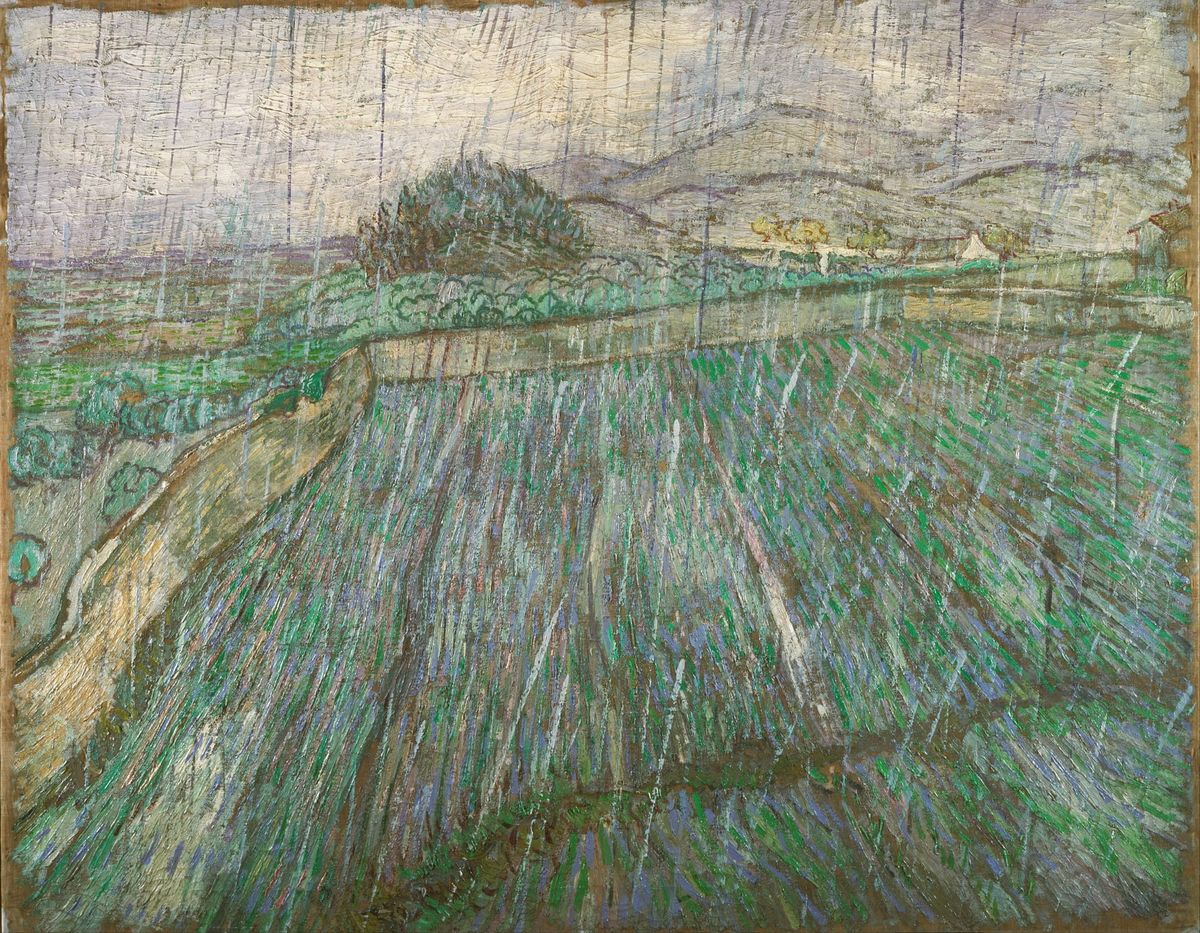
빈센트 반 고흐(Vincent van Gogh)가 1889년 11월 프랑스 생레미의 생폴 드 모졸 요양원에서 완성한 대표적인 유화 풍경화입니다. 현재 미국 필라델피아 미술관(Philadelphia Museum of Art)에 소장되어 있으며, 캔버스 위에 유채로 제작된 이 작품의 실제 사이즈는 약 73.3 × 92.4 cm입니다. 요양원 창밖으로 펼쳐진 비 내리는 밀밭과 알피유 산맥의 풍경을 수직과 사선의 리드미컬한 선묘, 그리고 두터운 임파스토(Impasto) 기법으로 포착하여 대지를 적시는 빗줄기의 생생한 촉각성을 탁월하게 구현했습니다.
고흐는 물감을 캔버스 위에 두껍게 얹은 후, 하늘에서 대지로 세차게 쏟아지는 장대비를 은빛과 짙은 보랏빛의 가늘고 긴 사선 붓터치로 화면 전체에 교차시키며 배치했습니다. 빗물에 젖어 짙은 청록색과 황토색, 보랏빛으로 물든 들판의 흙과 풀잎의 질감은, 뒤편의 안개 낀 산등성이와 낮게 드리운 회색 구름과 어우러져 깊은 공간감과 대기감을 형성합니다. 일본 우키요에 판화인 우타가와 히로시게의 빗줄기 묘사에서 착안한 대담한 선의 중첩은 캔버스 표면에 살아 숨 쉬는 듯한 역동성을 불어넣습니다.
1889년 늦가을, 심신이 지친 상태로 요양원에 갇혀 지내던 고흐는 창살 너머로 매일같이 바라보던 사방이 담으로 둘러싸인 밀밭에 내리는 비를 묵묵히 관찰했습니다. 고흐에게 비는 단순한 기상 현상이 아니라, 메마른 대지를 적시고 새로운 생명을 잉태하기 위해 하늘이 내리는 정화의 의식이자 자신의 내면을 씻어내는 구원의 손길이었습니다. 그는 동생 테오에게 보낸 편지에서 비 내리는 들판의 광경을 묘사하며 비바람 속에서도 변함없이 굳건한 자연의 질서에 깊은 감명을 받았다고 전했습니다.
화면을 가로지르는 낮은 담장과 빗속에 아스라이 잠긴 농가의 지붕은 고립된 환경 속에서도 자연과 공존하는 인간의 소박한 안식을 보여줍니다. 미술사에서는 고흐가 서양의 전통적 원근법과 동양 판화의 평면적 선묘를 독창적으로 결합하여, 자연의 찰나적인 대기 현상을 영적인 숭고함과 실존적 감정의 분출로 승화시킨 후기 인상주의의 기념비적 명작으로 평가합니다.
관람객의 무의식적인 시선은 화면 전면을 비스듬하게 가로지르며 세차게 쏟아져 내리는 은빛과 짙은 보랏빛 빗줄기의 사선 필치에서 자연스럽게 출발합니다. 거센 빗방울이 대지에 닿아 일으키는 역동적인 물결과 차가운 빗소리의 리듬에 시선이 머무는 순간, 보는 이는 찰나의 침묵과 함께 비 내리는 가을 들판의 촉촉한 공기 속으로 단숨에 몰입하게 됩니다.
이어 시선은 빗물에 흠뻑 젖어 짙푸른 녹색과 보랏빛으로 일렁이는 전경의 밀밭 이랑을 따라 상승하여, 들판을 단단하게 감싸고 있는 비탈진 돌담의 완만한 대각선 궤적에 도달합니다. 비바람을 묵묵히 버텨내고 있는 흙과 돌의 단단한 질감에 시선이 머물며, 대지가 품고 있는 깊은 인내와 생명력을 마주하게 됩니다.
이후 시선은 담장 너머로 은은하게 번지는 안개 속의 푸른 알피유 산맥 능선과 빗구름이 자욱하게 내려앉은 캔버스 상단의 회백색 하늘을 훑은 뒤, 좌측 언덕길을 타고 다시금 전경의 촉촉한 흙바닥으로 부드럽게 내려앉습니다.
대지를 적시는 빗줄기의 시원한 파동을 따라 순환한 시선이 편안히 안착할 때, 관람객의 내면에는 복잡한 일상의 번뇌와 마음의 무거운 앙금이 깨끗하게 씻겨 내려가고, 거친 비바람 뒤에 찾아올 새로운 생명의 순환이 건네는 깊은 위로와 함께 흔들리지 않는 심리적 안도감이 가득 차오르게 됩니다.
Rain
Painted by Vincent van Gogh in November 1889 during his stay at the Saint-Paul-de-Mausole asylum in Saint-Rémy-de-Provence, France, this monumental landscape resides in the permanent collection of the Philadelphia Museum of Art in Pennsylvania, United States. Executed in oil on canvas, the actual size of the work is approximately 73.3 × 92.4 cm. Capturing the rain-swept enclosed wheat field and the distant Alpilles mountains through rhythmic diagonal striations and dense impasto, the painting translates the atmospheric phenomenon of falling precipitation into a profound tactile reality.
Van Gogh applied unmixed paint in dense layers, superimposing a curtain of fine, angled slashes in silver-grey and deep violet across the entire canvas to represent the relentless downpour. The saturated field, rendered in vibrant ribbons of viridian, ochre, and slate-blue, contrasts against the misty contours of the background hills and the heavy overcast sky. Inspired by the graphic conventions of Japanese ukiyo-e prints, particularly the woodcuts of Utagawa Hiroshige, this bold network of linear incisions imparts a continuous kinetic vibration to the landscape.
During the late autumn of 1889, confined to the asylum while battling profound psychological distress, Van Gogh spent endless hours contemplating the walled field outside his window. To him, the falling rain was not merely weather, but a purifying force that cleansed the earth and nurtured future growth, mirroring his yearning for emotional healing and spiritual clarity. In his letters to his brother Theo, he described how observing the storm-swept fields brought a deep sense of resignation and reverence for the enduring cycles of nature.
The low stone wall traversing the composition and the distant farmhouse nestled beneath the mist anchor the vast elemental scene in the reality of humble rural life. Art historians celebrate this work as an extraordinary Post-Impressionist milestone where Western atmospheric painting harmonized with Eastern linear precision, transforming a transient meteorologic moment into an anthem of existential resilience and cosmic harmony.
A viewer's subconscious gaze is intuitively anchored first by the dynamic diagonal slashes of falling rain slicing across the foreground canvas. Lingering upon these textured strokes that capture the physical descent of water onto the soil, the observer is immediately drawn into an atmosphere of quiet solitude, sensory coolness, and contemplative stillness.
The gaze then follows the furrows of the saturated wheat field, moving through the undulating strokes of dark green and violet up to the sturdy diagonal line of the low stone wall. Absorbing the solid, grounding presence of the masonry enduring the downpour, the viewer experiences a reassuring sense of stability and natural resilience.
The eye continues its ascent into the misty, lavender-toned slopes of the Alpilles and the sweeping grey clouds of the turbulent sky, taking in the full atmospheric depth before descending smoothly along the sloping left bank back into the fertile, rain-drenched earth.
Completing this visual and psychological circulation, the observer feels a profound release of modern tension. The cleansing rhythm of the rain washes away accumulated anxieties, leaving the viewer restored with a lasting sense of emotional purification, grounding tranquility, and enduring inner peace.
본 리뷰에서 작품을 제외한 컨텐츠의 저작권은 팔렛트제주에 있습니다.
"퍼블릭도메인 고전명화"를 제외한 모든 창작 콘텐츠는 저작권법 제4조 및 제10조에 의거하여 보호됩니다. 무단 도용시 저작권법 제136조(벌칙)에 의거, 당사의 사전 서면 승인 없는 저작권 침해 행위를 금지합니다.