블루오차드 Blue Fruit Orchards (Orchard with Blossoming Plum Trees / 과수원 풍경)
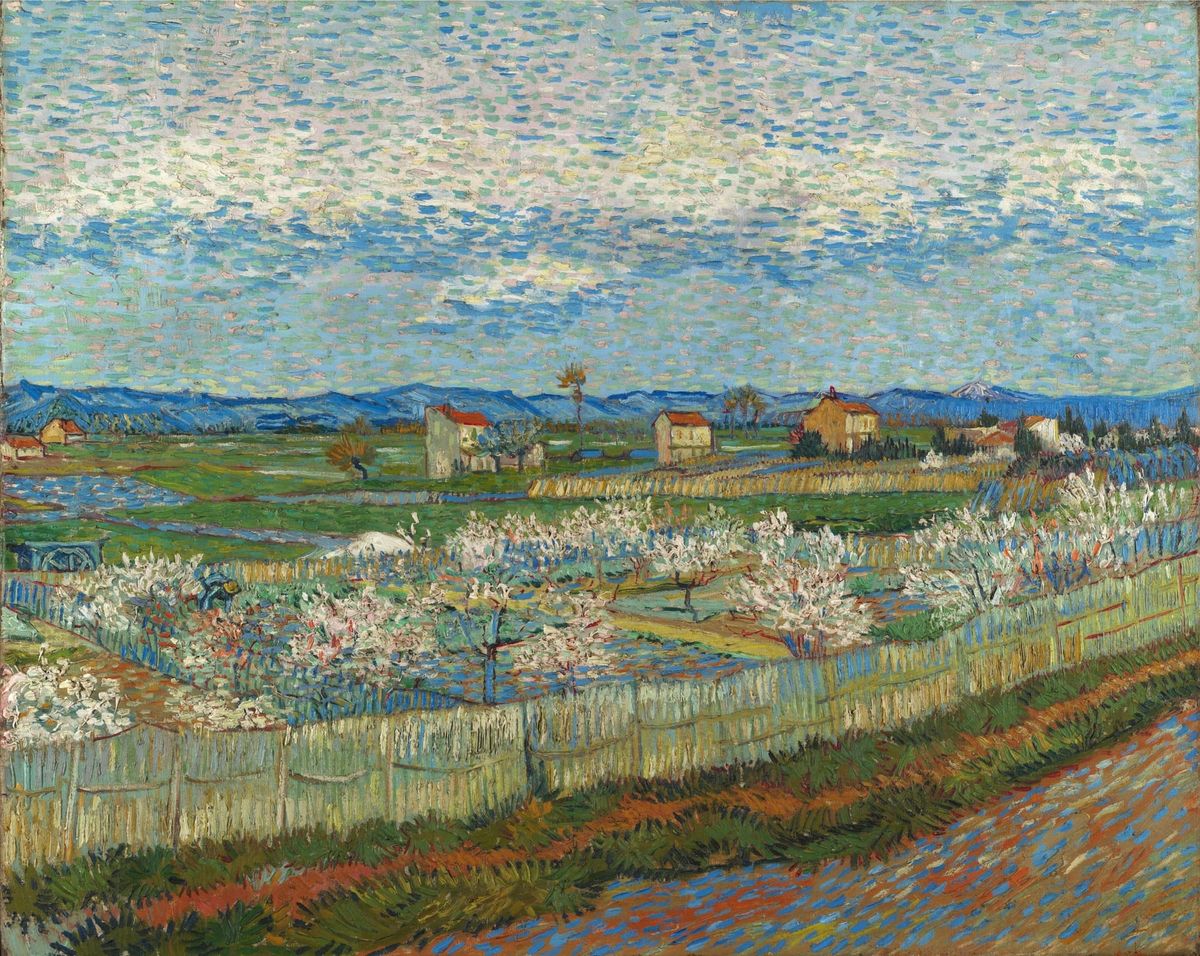
빈센트 반 고흐(Vincent van Gogh, 1853–1890)는 1888년 3월말에서 4월 사이 프랑스 남부 아를에 정착한 직후, 프로방스의 눈부신 봄 햇살 속에서 만개한 과수원의 풍경에 매료되어 자연의 순수한 생명력을 담아낸 일련의 연작을 제작했습니다.
이 작품은 1888년 4월에 그려진 유채화로, 야콥 바르트 드 라 파이유의 전작 도록 기준 공식 등록번호는 F554이며 실제 작품의 실측 규격은 72.0 × 92.0 cm입니다.
현재 네덜란드 크롤러 뮐러 미술관에서 소장하고 있습니다.
작가의 고뇌와 비하인드
아를로 이주한 직후 고흐는 맹렬하게 불어오는 프로방스의 거센 계절풍인 미스트랄과 맞서 싸워야 했습니다.
당시 그는 매서운 바람 때문에 이젤을 세우기조차 힘든 혹독한 기상 조건 속에서도, 만개한 과수원을 그리는 작업이야말로 겨울 동안 얼어붙었던 심신을 녹이고 삶의 환희를 되찾아 줄 구원이자 가장 큰 기쁨이라고 동생 테오에게 보낸 편지에서 거듭 강조했습니다.
화면 전면에는 굵은 나무 울타리와 대지를 가로지르는 밭고랑이 거칠고 두터운 붓질로 표현되어 있어 프로방스 대지의 단단한 체감을 전달합니다.
중경에는 하얗고 분홍빛으로 만개한 과수원 나무들이 사각의 구획을 이루며 화사하게 펼쳐져 있고, 그 주변을 감싸듯 짙은 초록색의 사이프러스 나무들이 수직으로 솟아올라 안정감을 더합니다.
원경의 지평선 위로는 붉은 지붕을 인 농가들과 멀리 아스라이 펼쳐진 푸른 산 능선, 그리고 점묘법적인 터치로 가득 채워진 청명한 하늘이 어우러져 남프랑스의 싱그러운 공간감을 완성합니다.
무의식 속 시선 및 심리 흐름
관람객의 시선은 가장 먼저 화면 하단의 울타리와 생동감 넘치는 밭둑의 질감에 자연스럽게 닿으며 대지의 포근한 온기를 느끼게 됩니다.
이어지는 시선은 하얗게 만개한 과수원 나무들의 화사한 군락을 거쳐, 화면 전반을 정돈해 주는 꼿꼿한 사이프러스 나무들의 수직적 리듬으로 부드럽게 이동합니다.
마지막으로 상단을 가득 채운 푸른 하늘빛 대기감으로 시선이 넓게 퍼져나가며, 혹독한 계절을 견뎌낸 자연이 선사하는 깊은 평온과 마음의 치유를 차분하게 체감하게 됩니다.
미술계의 평가와 조형미
미술사학계에서는 이 작품을 두고 고흐가 인상주의의 밝은 색채 감각과 일본 목판화의 평면적 구도를 완벽하게 결합하여 봄의 전율을 시각화한 수작으로 평가합니다.
화사한 흰색과 분홍빛 블로섬, 대지의 따뜻한 황토빛, 그리고 차가운 청색 계열의 하늘이 이루는 대조는 화면 전체에 깊은 시각적 울림을 부여합니다.
눈에 보이는 풍경의 단순한 재현을 넘어, 화가가 새로운 희망을 품고 마주한 자연의 찬란한 호흡을 캔버스 위에 영원히 아로새긴 위대한 미술사적 성취입니다.
Orchard with Blossoming Fruit Trees
Vincent van Gogh captured the exuberant vitality of spring in Provence after settling in Arles in April 1888, pouring his creative energy into a celebrated series of blossoming orchard landscapes.
Created in April 1888, this oil on canvas is cataloged as F554 in J.B. de la Faille's catalogue raisonné and measures 72.0 × 92.0 cm.
The painting is currently housed in the Kröller-Müller Museum in Otterlo, Netherlands.
During his early weeks in Arles, Van Gogh faced intense physical trials, most notably battling the fierce and unrelenting regional winds known as the mistral.
Despite the extreme weather conditions that made setting up an easel outdoors an arduous daily struggle, he found profound psychological refuge and spiritual renewal in painting the flowering fruit trees, writing enthusiastically to his brother Theo about how deeply this vibrant rebirth sustained his troubled mind.
The foreground is anchored by a rustic wooden fence and structured furrows rendered with expressive, tactile brushstrokes that convey the tangible mass of the earth.
In the middle ground, orchards of blossoming white and pink trees unfold in organized geometric plots, flanked by slender, vertical cypress trees that provide a calming structural rhythm.
In the distant background, red-roofed farmhouses, rolling blue hills, and a luminous sky composed of short, dot-like strokes establish a vibrant atmospheric depth characteristic of southern France.
The viewer's gaze is initially drawn toward the textured fence and earthy tones spanning the lower foreground, establishing a grounded sense of place.
The perspective then follows the luminous canopy of the blossoming fruit trees inward, resting upon the upright vertical accents of the cypresses in the middle ground.
Finally, the eye ascends into the expansive blue sky at the upper register, allowing the observer to experience a tranquil psychological transition from earthly observation to an overwhelming sense of seasonal renewal.
Art historians regard this canvas as a masterwork of Van Gogh's Arles period, where the synthesis of Impressionist luminosity and Japanese print aesthetics celebrates the raw rebirth of nature.
The striking color harmony between the delicate white blossoms, the warm earthy terrain, and the cool blue sky generates an exceptional optical vibration and emotional resonance.
It stands as an enduring artistic monument that immortalizes the artist's visionary optimism and his profound communion with the blossoming earth.
본 컨텐트의 저작권은 팔렛트제주에 있습니다. 허가없는 무단전제를 금지합니다.
Copyright © Palette Jeju. All rights reserved. Unauthorized reproduction or redistribution is strictly prohibited.