베네수엘라 마이케티아의 가옥과 야자수 (Maison et palmiers à Maiquetía, 1852–1854)
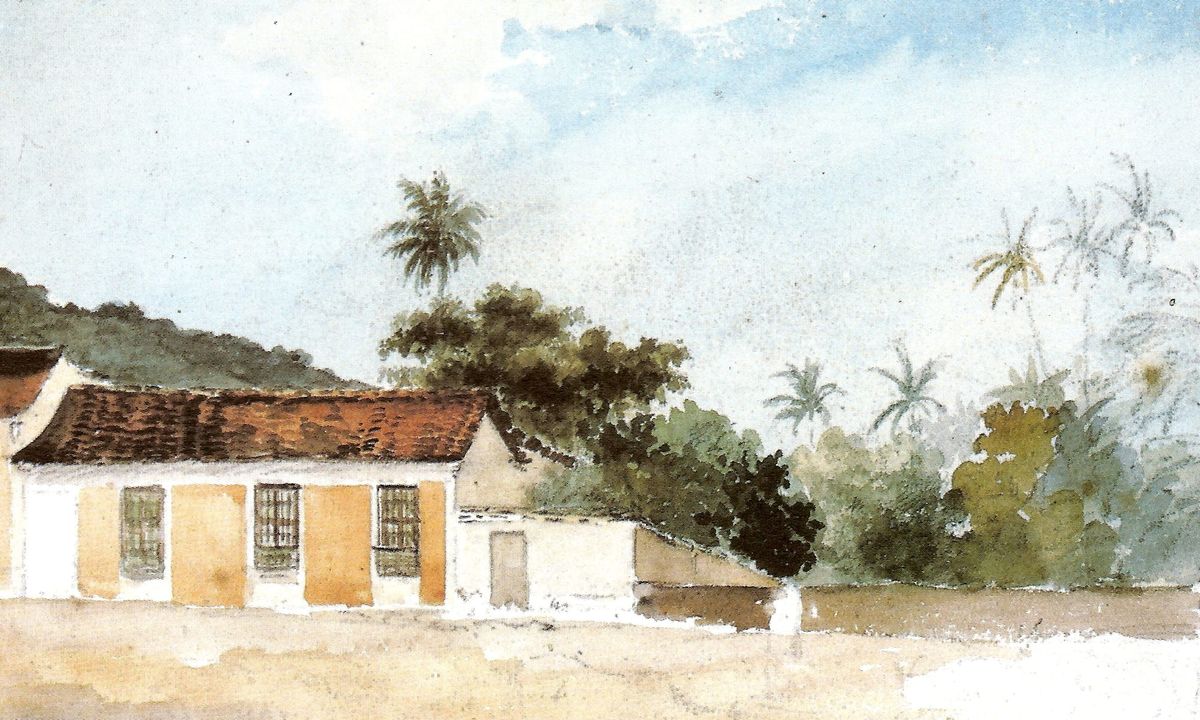
카미유 피사로가 파리로 건너가 본격적인 화가의 길을 걷기 전, 카리브해 세인트토머스 섬의 가업을 뒤로하고 덴마크 화가 프리츠 멜뷔와 함께 베네수엘라로 떠났던 청년 시절의 빛나는 예술적 여정을 증언하는 희귀한 초기작입니다.
당시 상점 점원으로 일하며 틈틈이 스케치를 하던 피사로는 가족들의 반대를 무릅쓰고 1852년 베네수엘라로 야반도주하듯 떠나 카라카스와 마이케티아의 이국적인 자연을 관찰하며 전업 화가로서의 기초를 다졌습니다. 종이 위에 맑고 투명한 수채 물감으로 완성된 가로 22cm, 세로 13.5cm 크기의 이 귀중한 소품은, 훗날 인상주의 거장이 지니게 될 날카로운 공간 지각력과 빛에 대한 천부적인 감수성이 이미 20대 초반에 태동하고 있었음을 선명하게 보여줍니다.
관람자의 시각 인지 체계는 화면 좌측 전경에 밝은 황토색 벽면과 붉은 기와지붕을 드러내며 자리 잡은 단층 가옥의 기하학적 형태에 가장 먼저 닻을 내립니다. 햇빛을 직접 받아 환하게 빛나는 벽면과 짙은 갈색 처마, 그리고 창살의 뚜렷한 명암 대비는 시각 피질의 중심와를 즉각 포획하며 화면의 조형적 기준점을 확립합니다.
이어서 시선은 가옥 뒤편으로 울창하게 우거진 짙은 초록빛 수풀과 그 위로 시원하게 솟아오른 야자수의 수직적 실루엣을 따라 우측 상단으로 자연스러운 도약 안구 운동을 진행합니다.
섬세한 붓질로 처리된 야자수 잎들의 율동감과 맑은 푸른 하늘의 투명한 여백을 스쳐 우측 중경의 아스라한 열대 나무들로 이어지는 시선의 흐름은, 평면의 스케치를 개방감 넘치는 3차원의 열대 공간으로 시원하게 확장합니다.
맑은 수채화 특유의 여백과 쏟아지는 태양광의 순수한 조화가 망막 위에서 통합되는 순간, 관람자는 복잡한 시각적 피로를 덜어내고 청량한 바람이 부는 이국적 휴양지에 홀로 서 있는 듯한 가벼운 심리적 해방감과 맑은 평온에 도달하게 됩니다.
이 시기 피사로가 멜뷔와 함께 베네수엘라의 해변과 정글을 누비며 남긴 수채화 스케치북들은 전통 아카데미즘의 인위적인 교육을 거치지 않은 상태에서 오직 현장의 자연광만을 길잡이 삼아 사물의 본질을 파악했던 독자적인 수련의 결과물이었습니다.
이 2년간의 남미 체류 경험은 피사로에게 야외 사생에 대한 확고한 신념을 심어주었으며, 훗날 그가 파리로 건너가 클로드 모네, 카미유 코로와 교류할 때 기성 화단에 얽매이지 않는 자유롭고 대담한 야외 빛 탐구로 직행할 수 있었던 결정적인 원동력이 되었습니다.
열대의 작열하는 태양빛을 인위적인 과장 없이 담백하고 정갈한 필치로 기록한 피사로의 베네수엘라 풍경화는, 현대 미술사에서 인상주의의 위대한 출발점이자 대가로서의 운명적 여정을 알린 기념비적인 청년기 유산으로 소중하게 평가받고 있습니다.
House and Palms in Maiquetía (Maison et palmiers à Maiquetía, 1852–1854)
Before Camille Pissarro ventured to Paris to formalize his artistic career, he embarked on an audacious formative journey to Venezuela alongside Danish painter Fritz Melbye, leaving behind his family's commercial business on the island of St. Thomas.
Having previously worked as a clerk while sketching in secret, the determined young artist braved parental opposition in 1852 to capture the untamed tropical landscapes of Caracas and Maiquetía, laying the essential groundwork for his vocation. Measuring 13.5 by 22 cm, this intimate watercolor on paper stands as an invaluable artifact from his youth, demonstrating that the future Impressionist master possessed an innate sensitivity to natural light and spatial balance in his early twenties.
The observer’s perceptual framework immediately anchors upon the geometric clarity of the single-story colonial residence in the lower-left foreground, where sunlit ochre walls contrast against the warm terracotta roof tiles. This vibrant play of architectural light and deep eaves stimulates the fovea, establishing an intuitive foundation for visual balance.
From this architectural nexus, the ocular trajectory tracks the lush foliage behind the dwelling, climbing smoothly along the vertical rhythms of slender palm trees silhouetted against the open sky.
Tracing the airy, feathered foliage as it recedes into the soft horizon on the right, the visual cortex synthesizes Pissarro's delicate, transparent washes into an expansive three-dimensional coastal atmosphere.
As the pristine paper reserves and vibrant daylight integrate into a unified visual sensation, the viewer shifts from analytical observation into an unencumbered state of psychological release, gently attuned to the tranquil warmth of the tropical breeze.
During these formative years in Venezuela, Pissarro's intensive field studies alongside Melbye bypassed rigid academic formulas, cultivating an uncompromised devotion to direct observation en plein air.
This foundational South American experience instilled a lifelong reverence for unfiltered natural light, providing the vital confidence that later empowered Pissarro to pioneer the Impressionist movement alongside Claude Monet and Camille Corot in France.
By rendering the incandescent radiance of the tropics with restrained elegance and genuine clarity, Pissarro's early Venezuelan sketches remain celebrated across art history as the luminous prologue to a transformative modern career.
본 콘텐츠의 저작권은 저작권자에게 있으며, 무단 전재 및 재배포를 금합니다.