방목지의 당나귀들 - Donkeys at Pasture
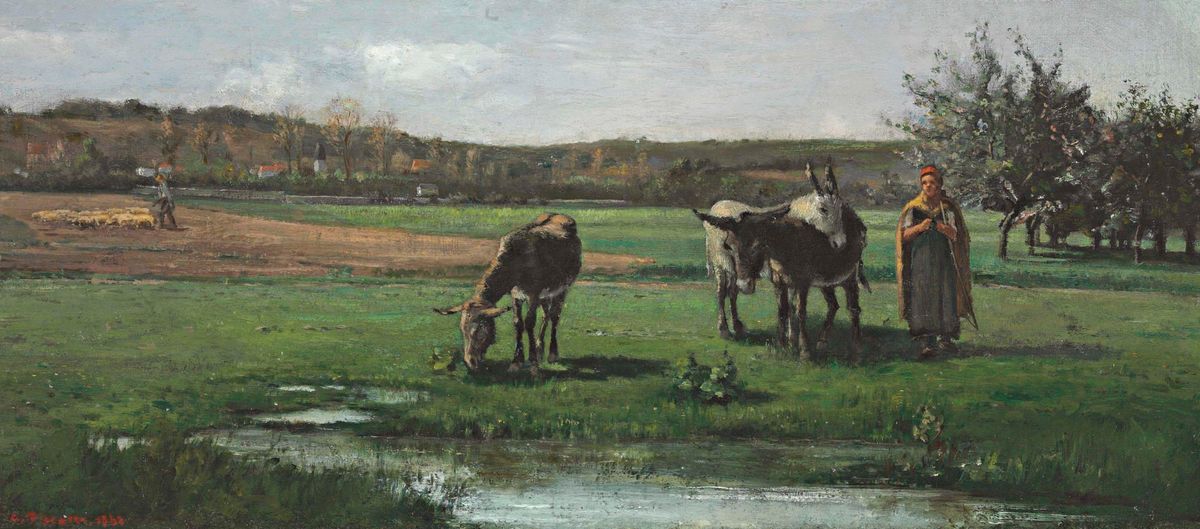
프랑스 인상주의의 든든한 아버지이자 빛의 탐구자였던 카미유 피사로(Camille Pissarro)가 1862년에 완성한 '방목지의 당나귀들(Ânes au pâturage / Donkeys at Pasture)'은 캔버스에 유채(Oil on canvas)로 제작된 귀중한 초기 명작입니다. 가로 51.5cm, 세로 21.5cm의 독특한 파노라마 비율을 지닌 이 작품은 현재 개인 소장처(Private Collection)에 보관되어 있습니다.
이 그림에는 청년 시절 피사로의 애틋한 사랑과 치열했던 예술적 방황에 얽힌 감동적인 일화가 깃들어 있습니다. 당시 30대 초반의 피사로는 어머니의 집에서 일하던 하녀 줄리 벨레(Julie Vellay)와 깊은 사랑에 빠졌습니다. 부유한 상인 가문이었던 그의 부모는 신분 차이를 이유로 두 사람의 만남을 극렬히 반대하며 경제적 지원을 완전히 끊어버렸습니다. 그러나 피사로는 사랑과 예술을 모두 지키기 위해 파리 근교 시골 마을로 거처를 옮겨 극심한 가난 속에서도 묵묵히 붓을 들었습니다.
화려한 귀족의 말이나 화려한 전원 풍경 대신, 피사로는 가장 낮고 묵묵하게 농가의 짐을 지는 동물인 당나귀와 소박한 시골 여인의 일상을 택했습니다. 특히 1870년 프로이센-프랑스 전쟁 때 그의 초기작 대부분이 군홧발에 짓밟혀 파괴되었기 때문에, 전란을 피해 기적처럼 살아남은 1860년대 초의 이 작품은 피사로의 초기 회화 세계를 증명하는 보물 같은 유산입니다. 훗날 미술사학자들은 이 작품을 두고 바르비종파의 자연주의적 사실감과 향후 인상주의로 꽃피울 섬세한 야외 광선 묘사가 완벽하게 결합한 초기 걸작으로 평가하고 있습니다.
작품을 마주할 때 우리의 시선은 전면 물웅덩이에 맑게 맺힌 하늘의 반영을 딛고, 중앙에서 고개를 숙인 채 풀을 뜯는 당나귀의 묵직한 실루엣에 자연스럽게 닿습니다. 이어 오른편에서 정답게 머리를 맞대고 있는 두 마리의 당나귀와 붉은 두건을 쓰고 뜨개질을 하며 서 있는 여인의 온화한 자태로 시선이 부드럽게 이어집니다.
시선은 다시 좌측 들판에서 양 떼를 몰고 있는 목동의 움직임을 따라 완만하게 이동하며, 저 멀리 숲과 작은 마을의 붉은 지붕들이 점점이 박혀 있는 완만한 구릉지대로 확장됩니다. 마지막으로 파노라마처럼 시원하게 펼쳐진 하늘과 부드럽게 흐르는 구름의 결을 올려다보며 전원 전체의 평화로운 대기를 만끽하게 됩니다.
이러한 시각적 흐름은 관람자의 무의식 속에 깊은 정서적 안정과 평온한 안도감을 불러일으킵니다. 낮게 깔린 푸른 초원과 흙빛 대지의 조화는 복잡한 일상의 시각적 긴장과 스트레스를 부드럽게 누그러뜨립니다. 묵묵히 제 몫의 삶을 살아가는 동물들과 소박한 농촌의 풍경은 바라보는 이의 마음속 깊은 곳에 잃어버렸던 삶의 여유와 따스한 위로를 선물합니다.
Donkeys at Pasture - Ânes au pâturage
Painted in 1862 by Camille Pissarro, the revered mentor and foundational pillar of French Impressionism, Donkeys at Pasture (Ânes au pâturage) is an early oil on canvas masterpiece measuring 21.5 by 51.5 cm. Displaying an elegant and rare panoramic format, this luminous early composition is preserved in a prestigious private collection.
Behind this tranquil pastoral canvas lies a touching tale of romantic devotion and artistic conviction. In his early thirties, Pissarro fell deeply in love with Julie Vellay, who had worked as a maid in his mother's household. His bourgeois parents vehemently opposed the relationship due to social class differences and completely cut off his financial allowance. Undeterred, Pissarro moved to the modest countryside surrounding Paris, embracing poverty to protect both his love and his artistic independence.
Instead of depicting aristocratic horses or idealized romantic pastoral motifs, Pissarro chose the humble donkey, the enduring symbol of rustic manual labor, and the quiet dignity of a country girl. Because the vast majority of Pissarro's formative canvases were destroyed during the Franco-Prussian War of 1870, this rare surviving 1862 work stands as a priceless historical testament. Modern art historians celebrate it as a quintessential bridge where the grounded realism of the Barbizon school seamlessly merges with the fresh, open-air luminosity of early Impressionism.
Upon viewing the canvas, the spectator's gaze is effortlessly drawn across the foreground pool of water reflecting the pale sky, resting first on the lone donkey grazing peacefully in the green pasture. Our attention then glides naturally to the right, taking in the charming duo of resting donkeys and the quiet figure of the country girl with her red kerchief.
The eye continues along the open field toward the shepherd guiding his flock on the far left, before receding into the soft horizon dotted with rustic village roofs and gentle hills. Finally, the panoramic view carries the gaze across the expansive, cloud-dappled sky, capturing the tranquil breath of the open countryside.
This harmonious visual journey inspires a profound sense of inner calm and emotional grounding within the subconscious. The soothing tapestry of earth greens and soft browns eases mental fatigue, inviting the viewer into a sanctuary of stillness. Experiencing the honest, unhurried rhythm of nature nurtures the spirit with timeless serenity, simplicity, and deep pastoral peace.
본 리뷰에서 작품을 제외한 컨텐츠의 저작권은 팔렛트제주에 있습니다.
"퍼블릭도메인 고전명화"를 제외한 모든 창작 콘텐츠는 저작권법 제4조 및 제10조에 의거하여 보호됩니다. 무단 도용시 저작권법 제136조(벌칙)에 의거, 당사의 사전 서면 승인 없는 저작권 침해 행위를 금지합니다.