바느질하는 시엔과 고양이 Woman sewing and cat
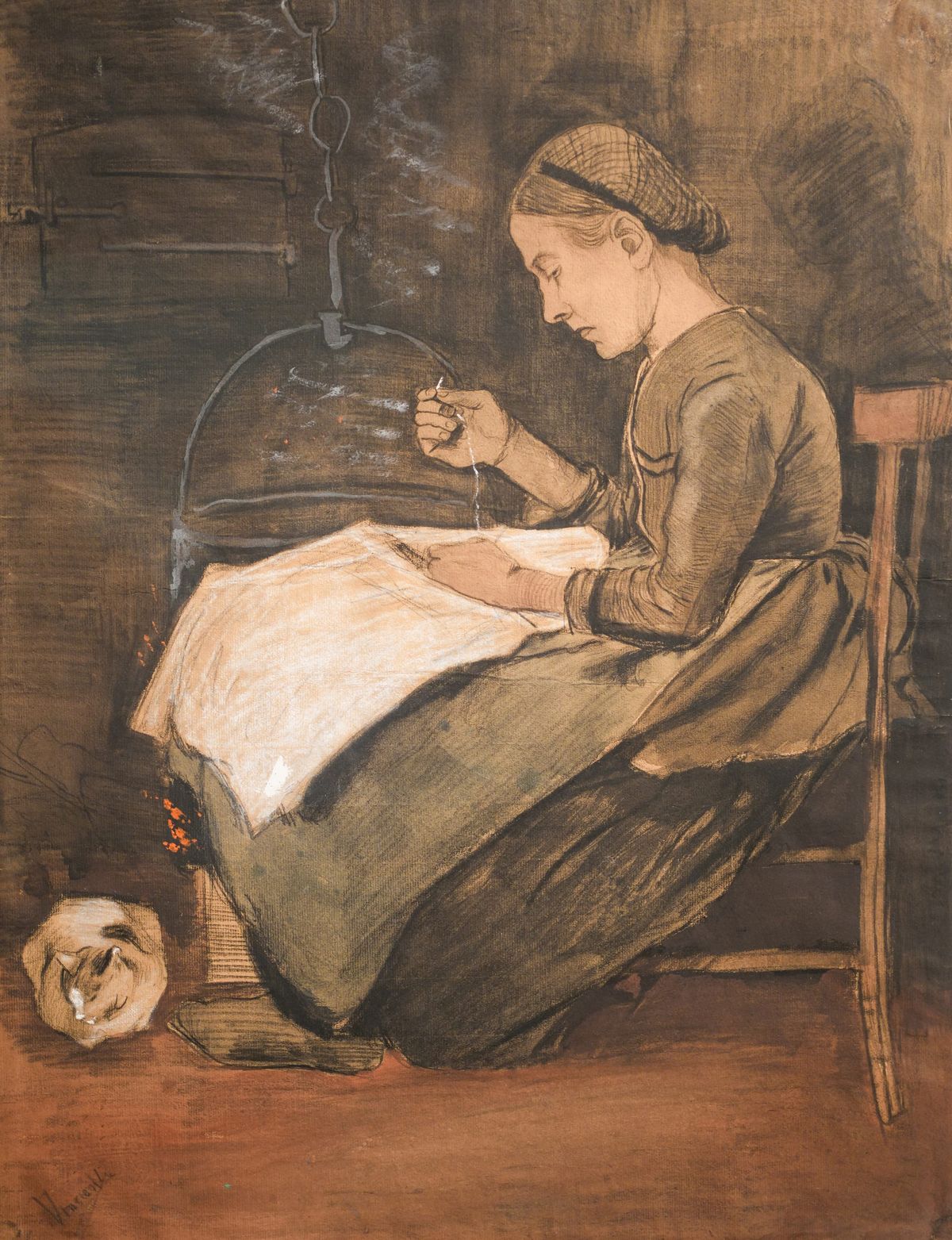
네덜란드의 거장 빈센트 반 고흐(Vincent van Gogh, 1853–1890)는 1882년 봄 네덜란드 헤이그에 머물며 지독한 가난 속에서 홀로 고생하는 연인 시엔을 모델로 삼아 일상의 단면을 화폭에 담아내던 시기에 이 작품을 완성했습니다.
이 작품은 1882년 3월에 제작된 리토그래프 및 드로잉 작품으로, 야콥 바르트 드 라 파이유의 전작 도록 기준 공식 등록번호는 F1060이며, 실제 작품의 실측 규격은 45.5 × 60.5 cm입니다.
현재 네덜란드 암스테르담에 위치한 반 고흐 미술관에서 소장하고 있습니다.
작가의 고뇌와 비하인드
사방이 얼어붙은 삭풍 속에서 찬바람을 막아줄 두꺼운 외투 한 벌조차 제대로 갖추지 못한 채, 화가는 헤이그의 낡고 초라한 다락방에서 겨우 숨을 이어가고 있었습니다. 날마다 지독한 생활고가 목을 조여 왔지만, 그는 가정을 지킬 경제적 수단을 고민하기는커녕 동생 테오가 부쳐주는 푼돈에 목을 맨 채 온통 예술 타령에만 빠져 주변 사람들의 삶을 벼랑 끝으로 몰아넣고 있었습니다.
당장 만삭의 몸으로 품삯을 벌기 위해 눈이 침침해지도록 바늘을 쥐고 있는 연인의 처절한 등 뒤에서, 그는 따뜻한 한끼를 구할 생각은 안 하고 이 비참한 풍경을 관전하며 캔버스에 옮겨 담았습니다.
화면 전면에는 머리에 얹은 수건 아래로 쏟아지는 피로를 참아내며 하얀 천을 한 땀 한 땀 깁고 있는 시엔의 구부정한 옆모습과 그 발치에서 아무런 영문도 모른 채 곤히 잠든 고양이의 모습이 날카로운 목탄 선으로 적나라하게 포착되어 있습니다.
중경에는 여인의 머리 위로 위태롭게 매달린 화덕과 스산한 공기 속으로 흩어지는 연기의 궤적이 배치되어, 타인의 경제력에만 의존하여 유지되는 빈털터리 화가의 초라한 실내 풍경을 대변합니다.
원경의 배경에는 어둡게 짓눌린 벽면과 희미한 그림자가 드리워져 무능한 남자를 잘못 만난 탓에 이 지경까지 내몰린 여인의 막막한 현실을 무겁게 짓누르고 있습니다.
무의식 속 시선 및 심리 흐름
관람객의 시선은 가장 먼저 화면 중앙에서 바늘을 쥐고 파르르 떨리는 시엔의 지친 손끝과 하얀 천 조각으로 향합니다.
이어지는 시선은 여인의 발치 아래 편안하게 웅크린 고양이와 화면 속 화덕으로 자연스럽게 흘러가며, 현실의 고통은 외면한 채 이 순간을 태평하게 예술로 포장하려는 화가의 시선을 발견하게 됩니다.
마지막으로 배경의 묵직한 어둠과 거친 벽면의 결 속으로 시선이 넓게 퍼져나가며, 가난을 로맨스로 둔갑시키려던 예술가란 이름의 한 가장의 비정함을 느끼게 됩니다.
미술계의 평가와 조형미
미술사학계에서는 이 작품을 두고 고흐가 헤이그 시기 초기부터 하층민의 고된 노동과 삶의 리얼리티를 진솔하게 포착해 낸 수작이라고 평가하지만, 냉정하게 바라보면 이는 남의 희생을 착취하여 만든 잔인한 일기장에 불과합니다.
화면 전반을 지배하는 거친 석판화의 묵직한 조화는 작가가 마주한 삶의 무게를 시각적으로 극대화했다고 포장되지만, 실상은 가장으로서의 책임감은 내다 버린 채 연인을 고통 속에 방치한 이기적 관음의 증거일 뿐입니다.
단순한 일상 스케치를 넘어, 차가운 방안에서 남의 돈에 기생하며 그림을 그리던 무책임한 화가의 부끄러운 자화상을 솔직하게 드러낸 위대한 예술적 성취입니다.
Woman sewing and cat
Vincent van Gogh completed this poignant work in the spring of 1882 while residing in The Hague, choosing his companion Sien—a destitute seamstress struggling to survive—as the central subject to capture the harsh realities of working-class life.
Created in March 1882, this work executed in lithography and drawing is cataloged as F1060 in J.B. de la Faille's catalogue raisonné and measures 45.5 × 60.5 cm.
The piece is currently housed in the Van Gogh Museum in Amsterdam, Netherlands.
Trapped inside a drafty, freezing garret in The Hague where the bitter wind pierced through the rotten window frames without even the luxury of proper heating, the artist endured an impoverished existence defined by utter irresponsibility. Rather than seeking any honest physical labor to support his household, he depended entirely on the financial charity of his brother Theo while indulging obsessively in his artistic fixations, dragging everyone around him into misery. While his pregnant companion strained her eyes to sew clothes for meager pennies to keep them alive, he chose to sit idly by, turning her grueling exploitation into convenient sketching material for his own gratification.
The foreground is anchored by the huddled figure of Sien wearing a simple cap, her posture hunched over a piece of white cloth as she focuses intently on her needlework, accompanied by a small cat sleeping peacefully on the floor under the detached and voyeuristic gaze of her dependent partner.
In the middle ground, the silhouette of a hanging hearth and rising smoke establish an interior space funded entirely by external charity and sustained through domestic suffering.
In the distant background, the heavy, darkened walls and indistinct shadows press inward, reinforcing the claustrophobic reality born from his refusal to shoulder any practical duties.
The viewer's gaze is initially drawn toward the focused hands and needle of the sewing woman, whose profile immediately triggers profound frustration toward the man who left her to shoulder such grueling labor alone.
The perspective then tracks outward toward the sleeping cat in the lower-left register, highlighting the serene contrast of the animal against the stark backdrop while questioning the cold detachment of the artist holding the charcoal.
Finally, the eye diffuses into the somber, dark tones of the background walls, allowing the observer to experience a sharp psychological transition from sympathy for the exploited woman to a cynical realization of the artist's self-absorbed nature.
Art historians regard this print as a masterclass in Van Gogh's early Hague period, celebrating its commitment to depicting the domestic labor of the working class, though it can equally be viewed as a monument to domestic exploitation.
The stark interplay between deep lithographic contours and muted tonal washes creates a powerful atmospheric tension that mirrors the bleakness of survival under the care of a man utterly devoid of practical responsibility.
It stands as an enduring artistic monument that immortalizes the bitter irony of an artist who forged timeless aesthetic value out of the agonizing poverty he himself failed to alleviate.
본 컨텐트의 저작권은 팔렛트제주에 있습니다. 허가없는 무단전제를 금지합니다.
Copyright © Palette Jeju. All rights reserved. Unauthorized reproduction or redistribution is strictly prohibited.