밤의 카페 테라스 - Café Terrace at Night
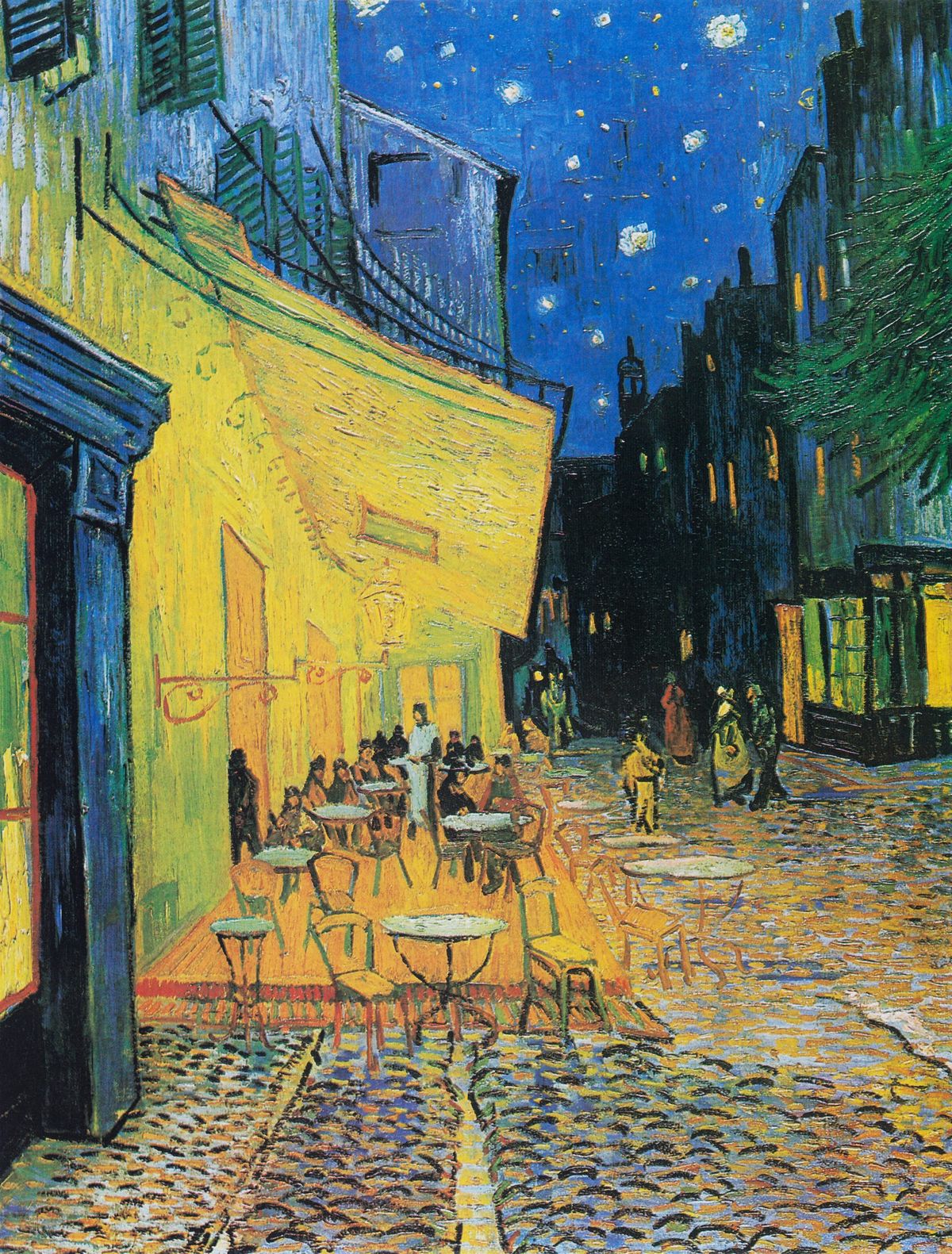
빈센트 반 고흐(Vincent van Gogh, 1853–1890)가 1888년 9월 프랑스 남부 아를(Arles)의 포럼 광장에서 완성한 '밤의 카페 테라스(Café Terrace at Night)'는 캔버스에 유채(Oil on canvas)로 제작된 풍경화입니다. 작품의 실제 규격은 세로 80.7cm, 가로 65.3cm이며, 현재 네덜란드 오테를로의 크뢸러 뮐러 미술관(Kröller-Müller Museum)에 영구 소장되어 있습니다.
고흐는 이 작품에서 전통적인 아카데미즘 화풍이 고수하던 검은색 물감을 단 한 방울도 섞지 않고, 오직 울트라마린과 코발트 블루의 심연, 그리고 찬란한 크롬 옐로와 주황빛의 강렬한 보색 대비만으로 밤의 시각적 실재감을 혁신적으로 재현했습니다. 가스등 불빛이 쏟아져 내리는 노란색 차양과 테라스 바닥은 나이프와 붓끝으로 물감을 두텁게 으깨어 올리는 특유의 임파스토(Impasto) 기법으로 질감의 밀도를 극대화했으며, 자갈길 바닥은 보라색, 옅은 청록색, 황토색의 작은 사선 터치들을 모자이크처럼 촘촘히 엮어 밤공기 속에서 진동하는 반사광의 찰나를 생생하게 포착했습니다.
이 그림은 고흐가 파리의 번잡함과 피로를 뒤로하고 남프랑스 아를에 도착해 예술적 전성기를 꽃피우던 1888년 가을, 야외에 이젤을 세우고 밤하늘 아래에서 직접 현장 사생을 감행한 역사적인 첫 번째 야경화입니다. 당시 고흐는 모파상의 소설 '벨아미(Bel-Ami)'에 묘사된 파리의 밤 풍경과 카페의 활기찬 정경에 깊이 매료되어 있었으며, 문명화된 도시의 조명과 대자연의 밤하늘이 만나는 지점에서 일어나는 색채의 마법을 화폭에 온전히 담고자 했습니다.
그는 여동생 빌(Wil)에게 보낸 편지에서 "검은색을 전혀 쓰지 않고 오직 푸른색, 보라색, 초록색, 그리고 조명을 받는 공간의 황금빛과 유황빛만으로 밤을 그리는 일에 엄청난 희열을 느낀다"고 고백했습니다. 어둡고 차가운 밤의 침묵 속에서 마치 따뜻한 등대처럼 홀로 황금빛을 뿜어내는 카페 테라스는, 언제나 지독한 고독과 예술적 불화에 시달리던 고흐가 사람들의 온기와 유대감, 그리고 예술적 안식을 갈구하며 캔버스 위에 구현해 낸 가장 따뜻한 영혼의 피난처였습니다.
일부 미술사학자들은 중앙의 흰 옷을 입은 웨이터와 그를 둘러싼 열두 명의 손님들의 구도적 배치를 두고, 고흐가 프로테스탄트 목사의 아들로서 무의식중에 '최후의 만찬'이라는 기독교적 도상과 영적 구원의 메시지를 세속의 카페 풍경 속에 은유적으로 직조해 넣은 것이라는 깊이 있는 해석을 제시하기도 합니다.
후대의 평단과 현대 미술사는 이 작품을 서양 회화사에서 야경을 다루는 패러다임을 바꾼 후기 인상주의의 기념비적인 최고 걸작으로 추앙합니다. 어둠을 빛의 결핍이 아닌 색채의 풍요로움으로 해석한 고흐의 혁신적인 시각은 훗날 탄생한 '론강의 별이 빛나는 밤'과 '별이 빛나는 밤'으로 이어지는 기념비적인 우주적 밤 풍경 연작의 결정적 모태가 되었으며, 20세기 야수파와 표현주의 화가들에게 색채 해방의 결정적인 영감을 제공했습니다.
관람자의 시선은 가장 먼저 화면 좌측 상단을 압도적인 존재감으로 밝히는 황금빛 차양과 타오르는 듯한 가스등의 찬란한 광휘로 빨려 들어갑니다. 이어 테라스 아래 옹기종기 모여 앉아 담소를 나누는 인물들과 흰 옷을 입은 웨이터의 움직임에 머문 뒤, 급격하게 수렴하는 투시원근법을 따라 화면 우측 깊숙한 밤거리로 이동하여 어둠 속을 산책하는 행인들과 아를의 옛 건축물 실루엣을 자연스럽게 훑게 됩니다. 이후 시선은 건물 위로 솟아오른 푸른 밤하늘에 닿아, 마치 꽃송이나 눈부신 다이아몬드처럼 밤하늘을 수놓은 하얀 별들의 율동감을 따라 화면 전체로 유려하게 순환합니다.
심리적으로 관람자는 주변의 짙푸른 어둠과 완벽하게 대비되는 카페 테라스의 따스한 노란빛 안으로 들어서는 순간, 무의식중에 포근하게 감싸 안기는 듯한 즉각적인 심리적 안전감과 정서적 이완을 경험하게 됩니다. 차가운 현실의 불안과 외로움을 밀어내는 따뜻한 황금빛 온도는 일상에 지친 뇌의 피로를 씻어내며, 우주적인 밤하늘의 별빛과 지상의 인간적인 온기가 자아내는 완벽한 조화 속에서 깊은 낭만적 위안과 내면의 평온, 그리고 삶에 대한 따스한 긍정의 에너지를 가득 채워줍니다.
Café Terrace at Night
Painted by Vincent van Gogh (1853–1890) on the Place du Forum in Arles in September 1888, Café Terrace at Night is an iconic oil on canvas masterpiece measuring 80.7 cm in height and 65.3 cm in width. This landmark work is permanently preserved in the renowned collection of the Kröller-Müller Museum in Otterlo, Netherlands.
In this revolutionary nocturnal scene, Van Gogh boldly renounced the academic use of black pigment, relying entirely upon dramatic complementary contrasts between deep ultramarine, velvety cobalt, luminous violets, and intense chrome yellows. The glowing awning and sun-drenched terrace are constructed with heavy, sculpted impasto that captures the tactile vibration of incandescent gaslight, while the surrounding cobblestone pavement is built with rhythmic, mosaic-like dabs of lilac, pale teal, and warm ochre to reflect the shifting ambient luminescence of the evening.
The canvas marks the historical moment when Van Gogh first took his easel out into the nocturnal air to paint the night directly under the stars. Captivated by Guy de Maupassant’s literary depictions of vibrant Parisian café culture in the novel Bel-Ami, Van Gogh sought to capture the lyrical poetry where modern urban illumination meets the timeless expanse of nature.
Writing to his sister Wil, he expressed profound exhilaration: "It amuses me enormously to paint the night right on the spot. Normally one draws and paints the picture during the day after the sketch. But I find that it suits me to paint the thing immediately, without using any black, but only blues, violets, and glowing yellows." Amidst his deep personal loneliness and creative exile, this radiant café terrace functioned as a visual sanctuary of human warmth, fellowship, and emotional solace.
Modern art historians have further observed a profound spiritual undercurrent within the composition, suggesting that the central white-clad waiter surrounded by precisely twelve seated patrons subtly invokes the iconography of the Last Supper, infusing an everyday secular gathering with a sacred, humanist transcendence rooted in the artist's religious upbringing.
Contemporary scholarship and art history celebrate this painting as a transformative milestone of Post-Impressionism that forever redefined the artistic portrayal of the night. By demonstrating that darkness is not an absence of light but an arena of chromatic vibrancy, Van Gogh paved the way for his later celestial masterpieces, Starry Night Over the Rhône and The Starry Night, while offering fundamental inspiration to twentieth-century Fauvism and Expressionism.
A viewer’s gaze is instantaneously drawn to the radiant epicenter of golden light radiating from the cafe's large yellow canopy and brilliant lantern. The eye then explores the intimate figures seated at the round tables and the poised attendant before following the steep cobblestone perspective deep into the dark, mysterious street where shadowy pedestrians wander. Finally, the gaze ascends toward the deep cobalt sky, tracing the rhythmic, floral luminescence of the white stars before effortlessly circulating through the entire composition.
Psychologically, stepping visually into this warm enclave against the cool nocturnal void evokes an immediate feeling of emotional safety, sanctuary, and profound calm. The harmonic resonance between the comforting amber glow and the tranquil blue night eases mental fatigue, enveloping the observer in an enduring atmosphere of lyrical solace, contemplative stillness, and restorative optimism.
본 리뷰에서 작품을 제외한 컨텐츠의 저작권은 팔렛트제주에 있습니다.
"퍼블릭도메인 고전명화"를 제외한 모든 창작 콘텐츠는 저작권법 제4조 및 제10조에 의거하여 보호됩니다. 무단 도용시 저작권법 제136조(벌칙)에 의거, 당사의 사전 서면 승인 없는 저작권 침해 행위를 금지합니다.