밤하늘을 향해 타오르는 초록빛 불꽃과 인생의 여로, 사이프러스가 있는 길 Road with Cypress and Star
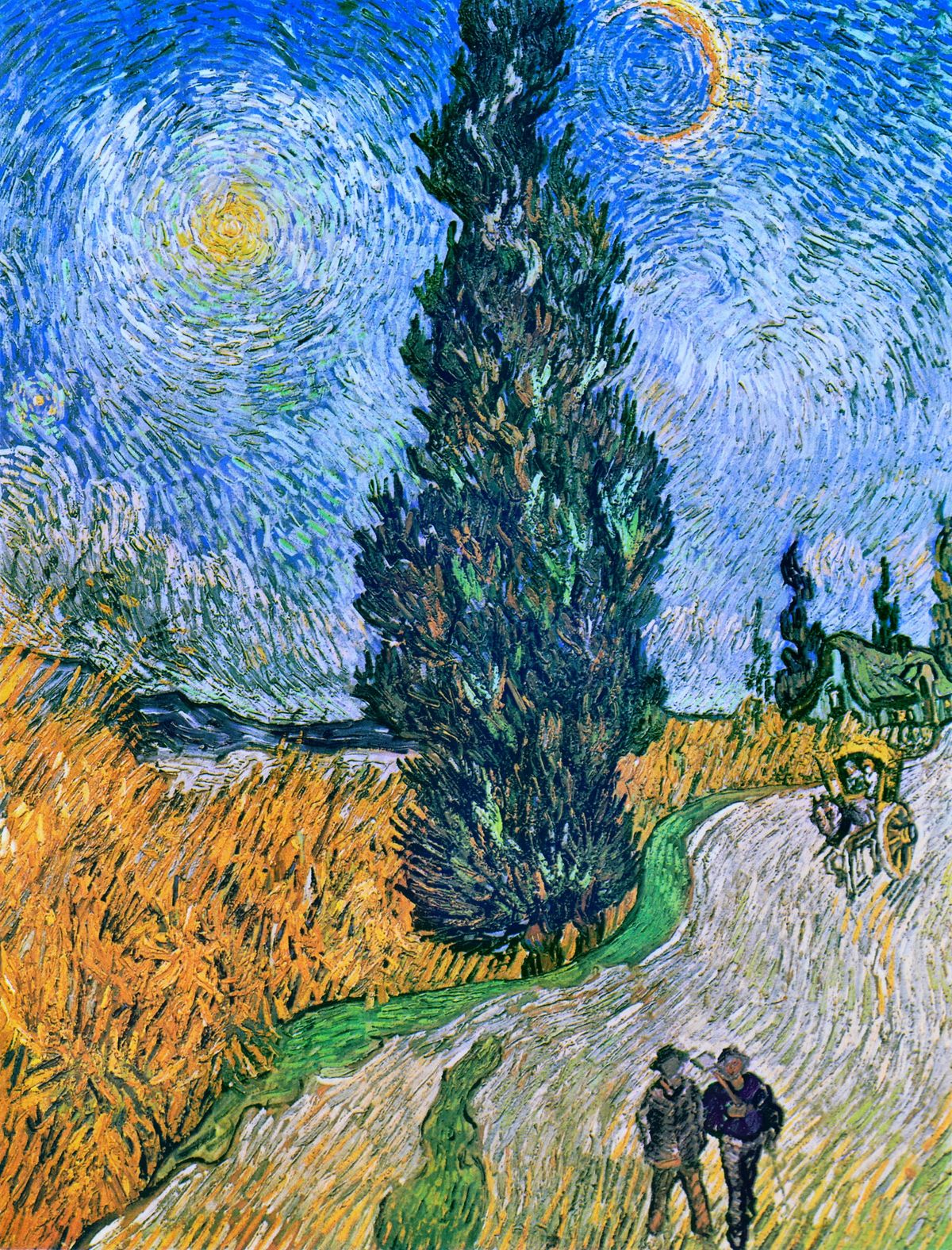
후기 인상주의의 거장 빈센트 반 고흐(Vincent van Gogh, 1853–1890)가 생레미 요양원을 떠나기 직전인 1890년 5월에 완성한 유화 《사이프러스가 있는 길(Road with Cypress and Star, 또는 별이 빛나는 밤의 프로방스 시골길)》은 92.0 cm × 73.0 cm 크기의 캔버스에 유채로 그린 대표작으로, 현재 네덜란드 오테를로의 크뢸러 뮐러 미술관(Kröller-Müller Museum)에 영구 소장되어 있습니다.
생레미 시절의 대미를 장식한 프로방스의 영혼과 사이프러스의 상징
1890년 5월, 1년간의 생레미 정신병원 생활을 마무리하고 파리 근교 오베르로 떠날 준비를 하던 고흐는 남프랑스 프로방스에서의 마지막 작별 인사와도 같은 기념비적 풍경화를 구상했습니다. 그는 프로방스 풍경의 정수를 담아내기 위해 자신이 그토록 매료되었던 사이프러스 나무와 소용돌이치는 밤하늘의 천체들을 하나의 화폭에 결합했습니다.
고흐는 사이프러스를 바라보며 "이집트의 오벨리스크처럼 완벽한 비율과 아름다움을 지닌 나무"라고 칭송하며, 죽음과 영원을 상징하는 이 짙푸른 수목을 화폭의 중심에 우뚝 세웠습니다. 화면 속에는 낫 모양으로 빛나는 초승달과 눈부신 황금빛 별, 황혼 무렵 길을 걷는 두 나그네와 마차가 함께 등장합니다. 동생 테오에게 보낸 편지에서 그는 프로방스의 밤길을 걸으며 느꼈던 숭고한 우주적 감흥을 고백했으며, 이 작품은 아를과 생레미를 거치며 완성된 고흐 특유의 소용돌이치는 필치와 색채의 집대성이 되었습니다.
무의식 속 시선의 수직 상승과 우주적 심리 파동
감상자의 시선은 화폭의 중앙을 거대한 초록빛 불꽃처럼 가로지르며 치솟은 사이프러스 나무의 짙은 어둠으로 가장 먼저 이끌립니다. 검푸른 청록색과 굽이치는 붓질로 빚어낸 거대한 나무의 수직성은 보는 이의 무의식 속에 강렬한 경외감과 묵직한 중압감을 선사합니다.
이어 시선은 사이프러스 줄기를 타고 밤하늘로 솟구쳐 올라가, 좌측에서 환하게 박동하는 샛별과 우측의 신비로운 초승달이 만들어내는 소용돌이치는 하늘의 율동 속으로 빠져듭니다. 그 후 시선은 굽이치는 흙길을 따라 화면 하단으로 내려와, 길모퉁이를 돌아 나오는 마차와 고단한 하루를 마치고 발걸음을 옮기는 두 나그네의 실루엣에 머뭅니다. 하늘의 영원한 빛과 지상의 덧없는 인간 삶이 이루는 대비 속에서, 관람자는 의식하지 못하는 사이 영원과 필멸의 경계를 넘나드는 깊은 서정적 울림과 고요한 평온에 젖어들게 됩니다.
영혼의 풍경화로 승화된 표현주의의 극치, 미술사적 평가
미술계는 《사이프러스가 있는 길》을 《별이 빛나는 밤》과 함께 반 고흐의 만년 예술혼이 도달한 가장 순수한 상징주의적 풍경화로 평가합니다.
현실의 풍경을 객관적으로 기록하는 차원을 완전히 벗어나, 굵고 리드미컬한 임파스토 터치와 역동적인 곡선으로 우주의 거대한 생명력을 시각화했습니다. 훗날 20세기 독일 표현주의와 현대 추상 미술의 영적 토대가 된 이 걸작은, 고통스러운 현실 속에서도 밤하늘의 별과 대지의 나무를 통해 무한한 영원을 꿈꾸었던 반 고흐의 찬란한 영혼의 자취로 남아 있습니다.
A Verdant Flame Reaching for the Celestial Heavens, Road with Cypress and Star
Painted in May 1890 at the culmination of his Saint-Rémy period by Vincent van Gogh (1853–1890), Road with Cypress and Star (also known as Country Road in Provence by Night) is an oil on canvas measuring 92.0 cm × 73.0 cm (36.2 in × 28.7 in), preserved in the permanent collection of the Kröller-Müller Museum in Otterlo, Netherlands.
Farewell to Provence: The Obelisk of Nature and Cosmic Synthesis
In May 1890, preparing to depart the Saint-Paul de Mausole asylum for Auvers-sur-Oise, Van Gogh created this monumental landscape as his ultimate tribute to Provence. Seeking to distill the spiritual essence of the southern countryside, he synthesized his most profound motifs—the dark, flame-like cypress, the undulating hills, and the pulsing nocturnal sky—into a singular visionary composition.
Vincent regarded the cypress with immense reverence, describing its lines and proportions as exquisite as an Egyptian obelisk. Anchoring the canvas with this ancient symbol of eternity and mourning, he illuminated the scene with a luminous crescent moon and a radiant evening star. Writing to his brother Theo, Vincent described the quiet transcendence of twilight walks along the country roads. The painting represents the poetic zenith of his expressive brushwork, uniting terrestrial labor with the infinite cosmos.
Psychological Trajectory of the Gaze and the Rhythm of Eternity
The observer’s subconscious gaze is immediately seized by the towering vertical mass of the central cypress tree. Rising like a dark, living flame sculpted with rhythmic ribbons of emerald and indigo impasto, this monumental form instills an immediate sensation of awe and gravity.
From this vertical anchor, visual perception ascends into the turbulent nocturnal sky, swept along the swirling concentric halos of the radiant star on the left and the luminous crescent moon on the right. The gaze then descends along the curving, ochre-tinted country road, encountering the horse-drawn cart and the quiet silhouettes of two laborers walking in twilight. Caught between the eternal rotation of the heavens and the transient cadence of human life, the viewer subconsciously internalizes a profound sense of cosmic harmony and contemplative solace.
Spiritual Landscape and the Height of Expressionism: Critical Significance
Art historians celebrate Road with Cypress and Star alongside The Starry Night as one of the ultimate masterpieces of Van Gogh’s symbolic vision.
Transcending conventional landscape conventions, Van Gogh transformed natural elements into expressive conduits of psychic and spiritual truth. The pulsating brushstrokes and dynamic linear rhythms laid the foundation for 20th-century Expressionism. Standing as a luminous farewell to the South of France, this masterwork captures an artist who, even amidst profound existential vulnerability, reached toward the infinite radiance of the universe.
Copyright © Palette Jeju. All rights reserved. Unauthorized reproduction or redistribution is strictly prohibited.
본 컨텐트의 저작권은 팔렛트제주에 있습니다. 허가없는 무단전제를 금지합니다.