바쟁쿠르 (Vachère et vache, Bazincourt, 1890)
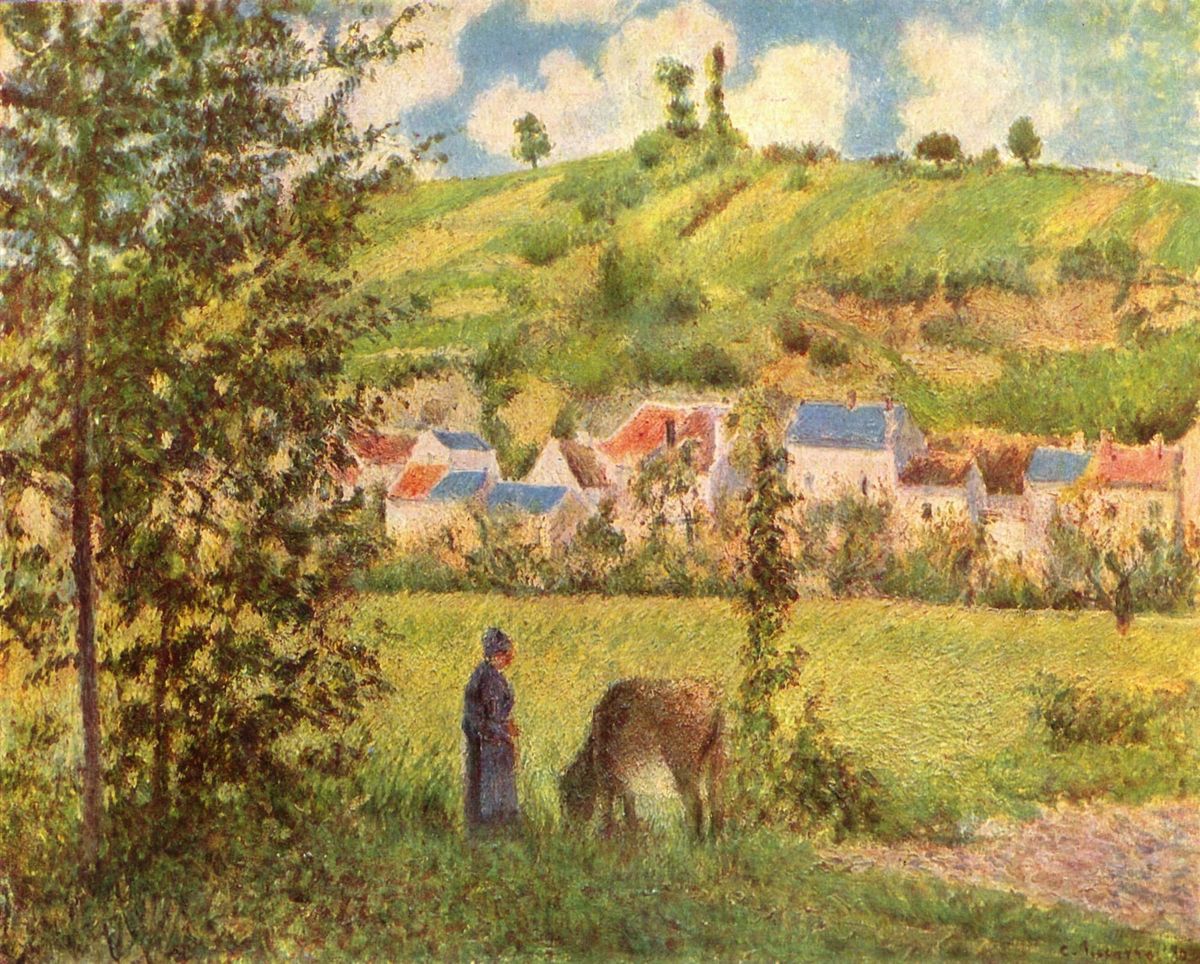
노르망디의 전원 마을 에라니에 머물던 카미유 피사로는 강 건너 이웃 마을 바쟁쿠르의 완만한 언덕과 들판을 평생에 걸쳐 가장 따뜻한 시선으로 관찰했습니다. 이 시기 피사로는 점묘주의의 엄격하고 과학적인 분할 기법을 깊이 탐구한 뒤, 이를 자신의 유연한 인상주의적 감수성과 조화롭게 융합하는 새로운 회화적 실험에 몰두하고 있었습니다.
가로 65cm, 세로 54cm 크기의 캔버스에 유채로 완성된 이 작품은 한여름 정오의 찬란한 태양빛 아래에서 펼쳐지는 평화로운 목가적 일상을 직조하듯 촘촘한 색채의 입자들로 완벽하게 포착해 낸 걸작입니다.
관람자의 시각 인지 체계는 화면 좌측 하단에 자리 잡은 푸른 옷의 여인과 풀을 뜯는 소의 묵직한 형태감에 가장 먼저 닻을 내립니다. 황금빛으로 물든 들판과 인물의 어두운 푸른빛 실루엣이 자아내는 뚜렷한 명암 대비는 시각 피질의 중심와를 즉각 포획하며 화면의 조형적 균형추 역할을 수행합니다.
이어서 시선은 좌측 전경의 무성한 나뭇가지들을 스치며 중경에 옹기종기 모여 있는 붉은색과 푸른색 지붕의 마을 가옥들로 자연스럽게 이동합니다. 집들의 수평적인 행렬을 지나 화면 상단을 웅장하게 채운 완만한 초록 언덕과 그 너머 뭉게구름이 떠 있는 푸른 하늘로 이어지는 시선의 상승 궤적은, 2차원의 평면을 층층이 쌓아 올린 풍성한 3차원 공간감으로 확장합니다.
햇살을 받아 잘게 부서지는 점묘의 색채소들이 망막 위에서 하나의 눈부신 빛의 파동으로 통합되는 순간, 관람자는 복잡한 감각적 자극을 내려놓고 자연과 인간이 완전한 조화를 이룬 목가적 고요 속에서 깊은 심리적 안도감과 내면의 평온을 체험하게 됩니다.
이 그림을 그릴 당시 피사로는 조르주 쇠라와 폴 시냐크의 신인상주의 이론을 적극적으로 실험하면서도, 지나치게 도식화된 기법에 매몰되지 않고 자연의 생생한 숨결을 살리기 위해 매일 수없이 붓을 덧칠하는 고된 노동을 감내했습니다.
아들 뤼시앵에게 보낸 편지에서 그는 "빛과 대기를 점으로 쪼개어 표현하는 과정은 엄청난 인내를 요구하지만, 완성된 화면이 뿜어내는 생명력은 그 무엇과도 비교할 수 없다"며 창작의 환희를 기록했습니다.
이러한 피사로의 끈기 있는 탐구는 훗날 점묘의 질서를 바탕으로 자신만의 강렬한 색채 세계를 구축해 나간 빈센트 반 고흐와 앙리 마티스에게 결정적인 조형적 영감을 주었습니다.
대지에 뿌리내린 소박한 삶을 과학적 색채 분할과 따뜻한 휴머니즘으로 승화시킨 피사로의 바쟁쿠르 풍경은, 현대 미술사에서 인상주의의 감각적 서정성과 근대 회화의 구조적 질서가 완벽한 정점을 이룬 기념비적 유산으로 확고하게 평가받고 있습니다.
Cowherd and Cow, Bazincourt (Vachère et vache, Bazincourt, 1890)
During his residence in the idyllic village of Éragny, Camille Pissarro maintained an enduring fascination with the gentle slopes and sunlit meadows of neighboring Bazincourt across the Epte River. Having rigorously explored the scientific principles of Pointillism, the master was actively synthesizing the structural discipline of divisionism with his innate Impressionist spontaneity.
Measuring 54 by 65 cm, this luminous oil on canvas stands as a magnificent testament to this transitional mastery, weaving thousands of vibrating color touches into a radiant tapestry of pastoral serenity beneath the warmth of the high midday sun.
The viewer's perceptual apparatus anchors immediately upon the solitary cowherd in her deep indigo dress and the grazing cow stationed in the lower left quadrant. The chromatic contrast between the dark figurative mass and the shimmering golden meadow stimulates the fovea, establishing an intuitive foundation for the entire compositional balance.
From this grounded nexus, the ocular trajectory glides through the delicate leafy foliage on the left toward the sun-dappled cluster of village cottages distinguished by their rhythmic red and slate-blue roofs. Ascending the terraced hillside toward the crest outlined against billowy summer clouds, the visual cortex synthesizes these woven color strokes into an expansive, three-dimensional pastoral panorama.
As the discrete touches of emerald, ochre, and cerulean fuse seamlessly within the observer's mind, active visual scanning dissolves into a profound state of contemplative stillness, attuned to the timeless communion between rural labor and the living earth.
While executing this work, Pissarro endured immense physical and mental strain to prevent the systematic dot technique from becoming rigid or sterile. In letters to his son Lucien, he reflected on the tremendous patience required to dissect light into pure pigment, rejoicing in the pulsating luminosity that only such meticulous division could achieve.
This relentless dedication deeply inspired younger avant-garde masters, notably Vincent van Gogh and Henri Matisse, who drew upon Pissarro’s structural color experiments to forge their own revolutionary paths.
By elevating humble agrarian existence through the synthesis of optical science and profound humanist warmth, Pissarro's view of Bazincourt is universally celebrated across art history as a timeless pinnacle that bridges Impressionist lyricism with the dawn of modern structural art.
본 콘텐츠의 저작권은 저작권자에게 있으며, 무단 전재 및 재배포를 금합니다.