바쟁쿠르 풍경 (Vue de Bazincourt, 1884)
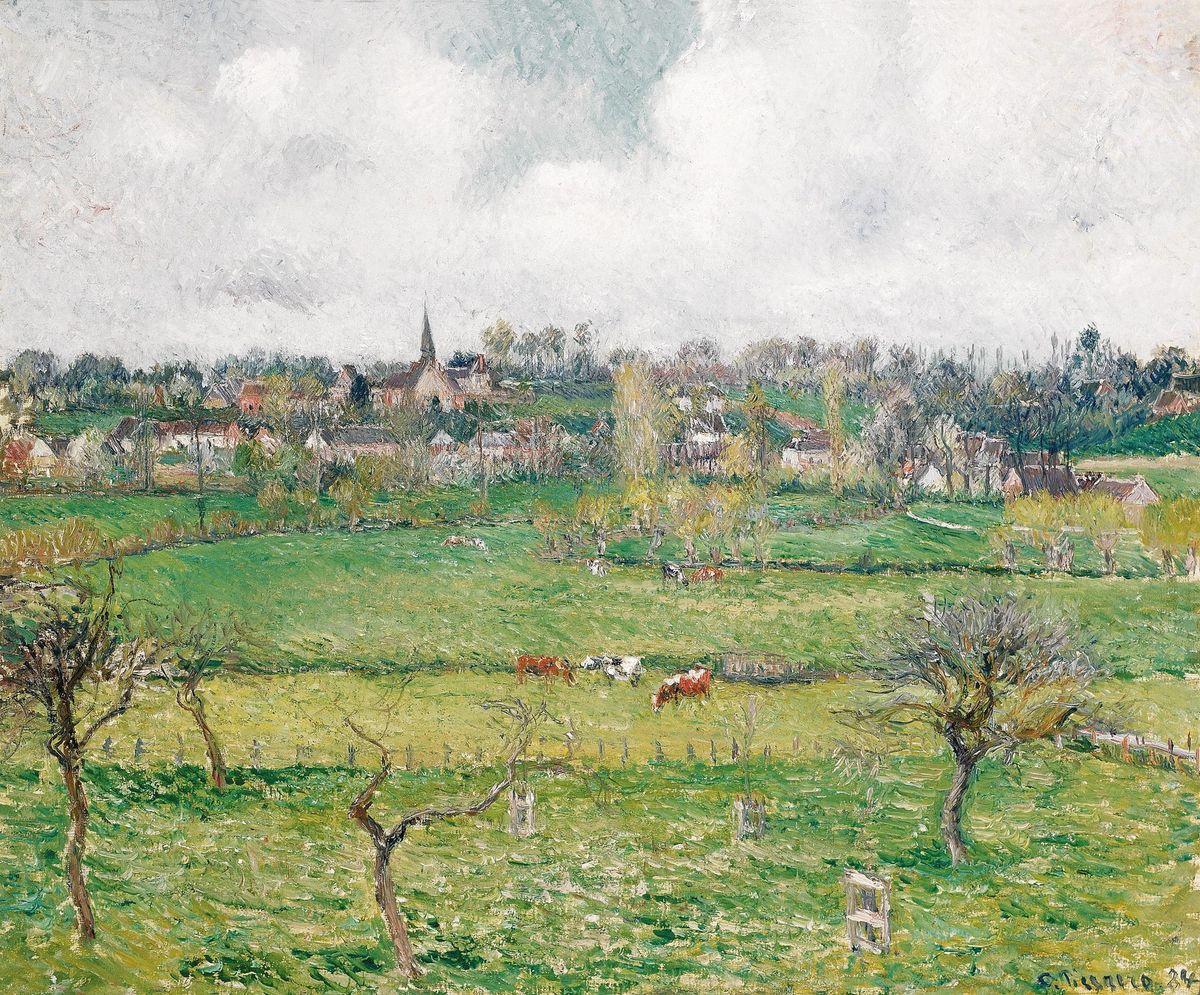
인상주의 회화의 거장이자 늘 새로운 조형적 도전을 멈추지 않았던 카미유 피사로는 1884년 봄, 가족들과 함께 노르망디 국경 인근의 작은 시골 마을 에라니 쉬르 엡트(Éragny-sur-Epte)로 이주했습니다. 이 시기 그는 집 앞마당과 아틀리에 창가에서 에프트 강 건너편의 이웃 마을 바쟁쿠르를 굽어보며 사계절과 시시각각 변화하는 자연의 숨결을 연작 형태로 기록하기 시작했습니다. 가로 65cm, 세로 54cm 크기의 캔버스에 유채로 완성된 이 작품은 에라니 정착 초기의 벅찬 감흥과 농촌 풍경에 대한 피사로 특유의 따뜻하고 정갈한 애정이 응축된 대표적인 전원 풍경화입니다.
관람자의 시각 인지 체계는 전경에 점묘에 가까운 짧고 리드미컬한 터치로 묘사된 과수원의 어린 나무들과 싱그러운 연둣빛 풀밭에 가장 먼저 닻을 내립니다. 질감의 밀도가 높은 하단부에서 출발한 시선은, 중경의 너른 초원에서 한가로이 풀을 뜯고 있는 붉고 흰 소들의 점경적 배치에 도달하며 수평적인 시각 안정감을 획득합니다. 이어 시선은 밭두렁의 완만한 대각선 구도를 따라 자연스러운 도약 안구 운동을 이어가며 저 멀리 마을 중심에 우뚝 솟은 교회의 뾰족탑과 붉은 기와지붕들로 상승합니다.
캔버스의 상단을 시원하게 채운 은은한 구름과 대기 원근법을 통해 점진적으로 흐려지는 숲의 능선은 관람자의 지각 공간을 2차원 평면에서 끝없이 펼쳐진 3차원 공간감으로 확장합니다. 분절된 색채의 조각들이 망막 위에서 하나의 서정적인 광경으로 통합되는 순간, 관람자는 일상의 번잡함을 잊고 부드러운 바람과 풀내음이 감도는 전원의 무한한 고요와 심리적 안도감을 만끽하게 됩니다.
이 작품을 완성한 직후 피사로는 조르주 쇠라, 폴 시냐크와 운명적인 만남을 가지며 점묘주의와 신인상주의라는 새로운 회화 혁명에 적극적으로 동참하게 됩니다. 자연을 순간적인 감각으로만 포착하는 것에 한계를 느끼고 보다 과학적이고 엄밀한 색채 분할을 모색하던 그의 과도기적 예술혼이 이 그림의 정교하고 직조된 듯한 붓터치 속에 고스란히 담겨 있습니다. 이미 인상주의의 최고 원로였음에도 젊은 후배들의 새로운 이론을 열린 마음으로 수용했던 그의 유연한 태도는 동료 예술가들에게 깊은 귀감이 되었습니다.
자연의 계절적 순환과 농촌의 소박한 아름다움을 진솔한 시각으로 찬미한 피사로의 바쟁쿠르 연작은, 현대 미술사에서 인상주의의 감각적 서정성과 신인상주의의 구조적 질서가 가장 완벽한 조화를 이룬 기념비적 수작으로 높이 평가받고 있습니다.
View of Bazincourt (Vue de Bazincourt, 1884)
As an enduring patriarch of the Impressionist movement and a relentless artistic pioneer, Camille Pissarro relocated with his family in the spring of 1884 to the pastoral village of Éragny-sur-Epte. From his home and studio overlooking the Epte River, he began capturing the neighboring hamlet of Bazincourt across the shifting light of changing seasons. Measuring 54 by 65 cm, this exquisite oil on canvas represents a masterwork from the beginning of his Éragny period, radiating his tender empathy for rural life and crystalline atmospheric clarity.
The viewer's perceptual apparatus naturally grounds itself upon the foreground meadow, where rhythmic, tactile strokes of vibrant greens and slender young orchard trees establish immediate optical engagement. From this textured base, the eye glides upward toward the midground pasture, anchored by the rhythmic placement of grazing cattle that impart horizontal equilibrium to the visual field. Guided by subtle diagonal field lines, the ocular trajectory seamlessly ascends toward the clustered village rooftops and the delicate vertical accent of the church steeple resting against the distant hillside.
Expanding into the soft, billowy expanse of the cloud-dappled sky, the composition employs atmospheric perspective to dissolve rigid boundaries into an expansive spatial depth. As the visual cortex synthesizes these woven, vibrant pigment touches into a luminous panorama, the observer experiences a transition from active visual scanning into deep contemplative stillness and pastoral serenity.
Completed just prior to Pissarro's pivotal encounter with Georges Seurat and Paul Signac, this painting reflects his critical stylistic transition toward Neo-Impressionism and Pointillism. Seeking a more structured, optical method to capture light without losing the tangible essence of the earth, the seasoned master embraced new aesthetic frontiers with extraordinary humility and vigor.
Celebrated for uniting delicate atmospheric lyricism with a rigorous architectural balance, Pissarro's Bazincourt series remains recognized across art history as a timeless milestone that bridged classical Impressionist spontaneity with the structured dawn of modern landscape art.
본 콘텐츠의 저작권은 저작권자에게 있으며, 무단 전재 및 재배포를 금합니다.