바쟁쿠르 풍경, 일몰 (세부) (Vue de Bazincourt, coucher de soleil - Détail, 1892)
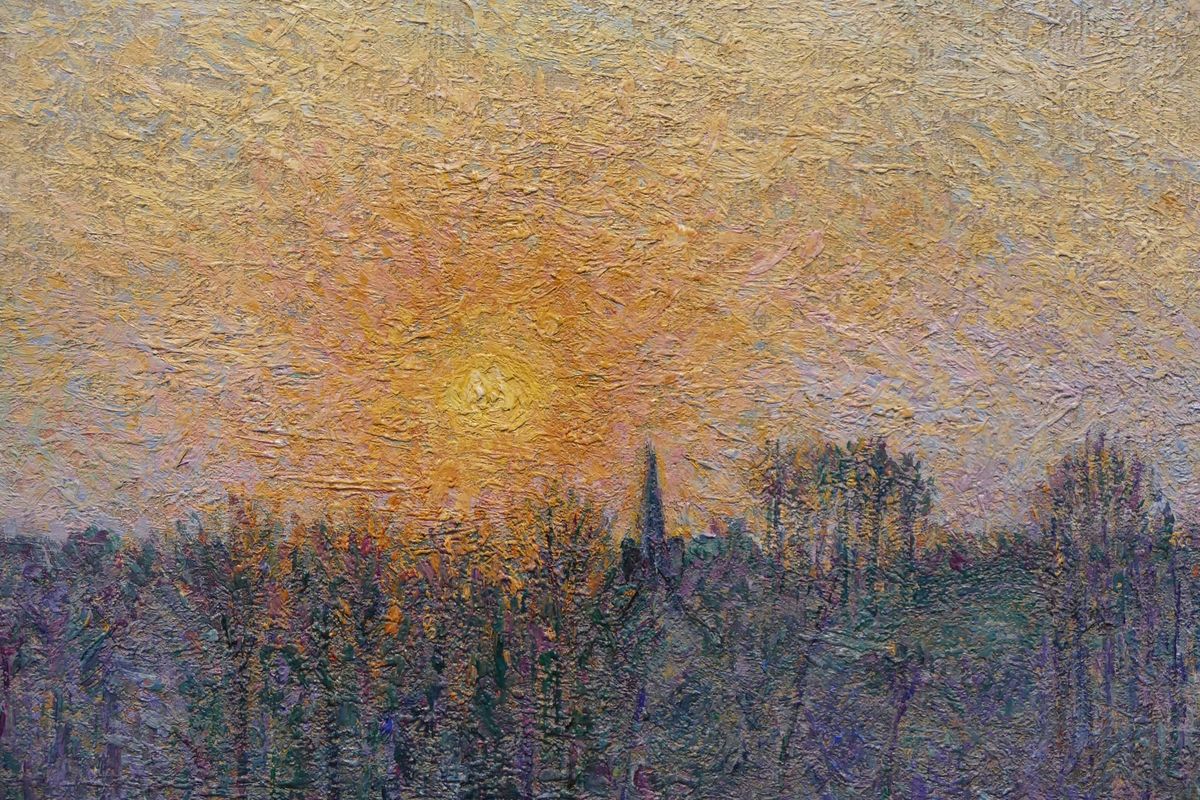
1890년대 초 에라니 쉬르 엡트에 머물던 카미유 피사로는 하루 중 가장 드라마틱한 빛의 향연이 펼쳐지는 해 질 녘의 대기 변화에 깊이 몰두했습니다. 점묘주의의 엄격한 기하학적 분할을 완전히 체화한 후, 이를 더욱 유연하고 표현력 넘치는 자신만의 후기 양식으로 발전시키던 피사로는 에프트 강 건너편 바쟁쿠르 마을 위로 저물어가는 태양의 장엄한 에너지를 캔버스에 응축시켰습니다. 전체 원작(가로 65cm, 세로 54cm)의 핵심 구심점을 확대한 이 세부 화면은, 수만 번의 정교한 붓질로 쌓아 올린 두터운 마티에르와 강렬한 광학적 색채 분할이 극적인 조화를 이루는 명장면입니다.
관람자의 시각 인지 체계는 화면 중앙 좌측 상단에서 타오르듯 찬란한 황금빛을 뿜어내는 태양의 발광체에 가장 먼저 정초합니다. 가장 높은 명도와 순도를 지닌 황금색 원형 광원은 시각 피질의 중심와를 즉각적으로 자극하며 화면의 절대적인 광학적 구심점을 확립합니다.
이어서 시선은 태양을 중심으로 사방으로 방사형을 그리며 뻗어나가는 짙은 오렌지빛과 분홍빛, 보랏빛 색채 입자들의 소용돌이를 따라 화면 상단의 대기로 자연스러운 도약 안구 운동을 진행합니다.
하늘의 따스한 온기를 머금은 시선은 점차 하강하여 화면 하단을 묵직하게 가로지르는 숲의 짙은 보랏빛과 청록빛 능선에 도달하며, 수풀 사이로 뾰족하게 솟아오른 바쟁쿠르 교회의 종탑 실루엣을 포착합니다.
상단의 뜨거운 태양광과 하단의 차가운 황혼의 그림자가 자아내는 보색 대비가 망막 위에서 하나의 웅대한 진동으로 통합되는 순간, 관조자는 하루의 마침표를 찍는 대자연의 장엄한 순환 앞에 서 있는 듯한 깊은 경외감과 함께 정서적 카타르시스, 그리고 내면의 깊은 평온을 체험하게 됩니다.
이 시기 피사로는 해가 지는 짧은 순간의 빛을 붙잡기 위해 동일한 풍경을 마주하고 분초를 다투며 물감을 중첩해 나갔습니다. 그는 물감을 팔레트에서 미리 섞지 않고 캔버스 위에 순수 원색의 미세한 점과 짧은 터치로 병치하여, 관람자의 눈에서 직접 빛의 파동으로 재조합되도록 유도하는 광학적 실험을 극한까지 밀어붙였습니다.
아들 뤼시앵에게 보낸 편지에서 그는 "일몰의 빛은 대지를 순식간에 보랏빛과 황금빛의 교향곡으로 바꾸어 놓는다. 이 찰나의 진동을 화면에 고정하는 것은 화가에게 주어진 가장 벅찬 도전"이라고 회고했습니다.
완성된 작품을 마주한 비평가들은 쇠라의 과학적 점묘를 한 단계 뛰어넘어 자연의 영혼과 원초적인 생명력을 불어넣었다며 "빛의 시학을 완성한 대가의 거룩한 성취"라는 격찬을 아끼지 않았습니다.
타오르는 태양과 대지의 침묵이 빚어내는 숭고한 조화를 독보적인 질감과 색채의 선율로 직조해 낸 피사로의 바쟁쿠르 일몰 풍경은, 현대 미술사에서 후기 인상주의가 감각적 빛의 묘사를 넘어 우주적 서정성을 획득한 기념비적인 걸작으로 확고하게 평가받고 있습니다.
View of Bazincourt, Sunset (Detail) (Vue de Bazincourt, coucher de soleil - Détail, 1892)
During the early 1890s in Éragny-sur-Epte, Camille Pissarro dedicated himself to capturing the most transient and dramatic atmospheric transformations of the day: the descent of the sun below the horizon. Having thoroughly assimilated the structural principles of divisionism, the master evolved toward a more fluid, deeply expressive late style, channeling the radiant energy of the setting sun over the neighboring village of Bazincourt. Enlarged from the focal heart of the full composition (measuring 54 by 65 cm), this detailed view showcases a richly woven impasto where thousands of deliberate pigment touches coalesce into a magnificent optical symphony of light and shadow.
The observer’s perceptual framework instantly anchors upon the radiant golden orb of the sun positioned in the upper-left quadrant. Bearing the highest degree of luminosity and chromatic purity on the canvas, this incandescent core captures the fovea, establishing an absolute optical and psychological center for the visual field.
From this luminous nucleus, the ocular trajectory expands outward along the vibrating radial rays of burnt orange, blush pink, and lavender that sweep across the atmospheric sky.
Descending from the celestial warmth above, the gaze settles upon the heavy, cool silhouettes of the forest ridge below, rendered in deep violets and muted viridians, before discerning the delicate vertical spire of the Bazincourt church steeple peering through the canopy.
As the powerful complementary contrast between the warm golden sky and the cooling earth synthesizes into a cohesive continuum within the visual cortex, active visual scanning dissolves into profound contemplative awe, immersing the viewer in the timeless and restorative majesty of twilight.
To capture this fleeting chromatic crescendo, Pissarro worked rapidly yet systematically against the falling dusk, applying pure touches of unmixed pigment directly onto the canvas to generate maximum optical vibration upon the viewer's retina.
In letters to his son Lucien, the master reflected that sunset transformed the landscape into an awe-inspiring symphony of violet and gold, remarking that capturing such evanescent vibrations remained the ultimate artistic test of his career.
Contemporary critics ardently lauded the resulting canvases, praising Pissarro for transcending mechanical divisionism to infuse the structured landscape with raw organic vitality and profound spiritual resonance.
Masterfully harmonizing incandescent solar power with the quiet solemnity of the resting earth, Pissarro's sunset study stands celebrated across art history as an enduring pinnacle of Post-Impressionist optical and poetic mastery.
본 콘텐츠의 저작권은 저작권자에게 있으며, 무단 전재 및 재배포를 금합니다.