백마들과 달구지 - White Horses and Carts
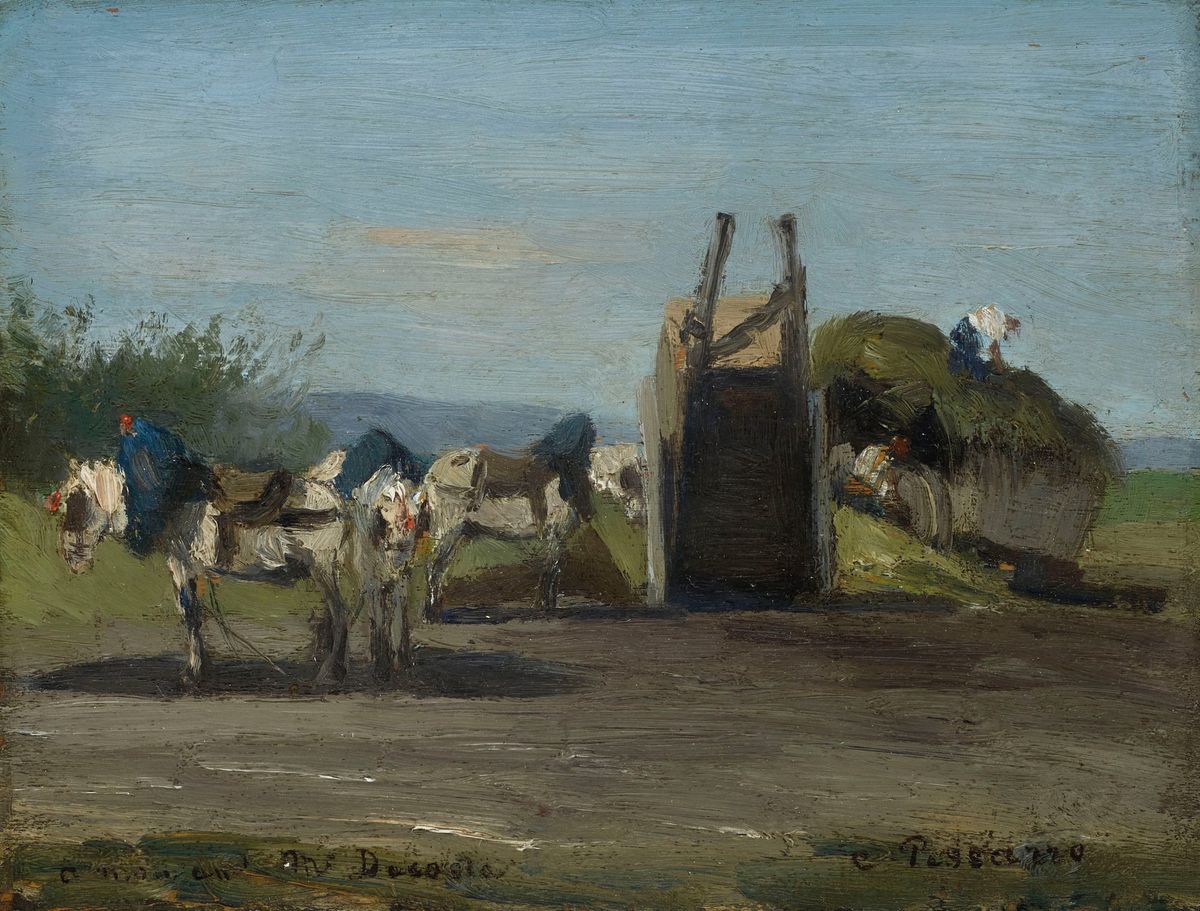
프랑스 인상주의의 든든한 맏형이자 대지의 빛을 사랑했던 카미유 피사로(Camille Pissarro)가 1860년대 초반에 완성한 '백마들과 달구지(Chevaux blancs et charrettes / White Horses and Carts)'는 목판(Panel)에 유채(Oil on panel)로 제작된 귀중한 초기 명작입니다. 가로 31cm, 세로 23cm 크기의 소박한 화폭에 농촌의 생생한 숨결을 담아낸 이 작품은 현재 개인 소장처(Private Collection)에 소중히 보관되어 있습니다.
이 그림에는 청년 시절 피사로의 치열했던 예술적 모험과 동료들과의 따뜻한 우정이 깃든 흥미진진한 비하인드 스토리가 담겨 있습니다. 당시 피사로는 부모의 반대를 무릅쓰고 가문의 하녀였던 줄리 벨레와 가정을 꾸리며 파리 근교 시골 마을에서 극심한 가난을 겪고 있었습니다. 그는 캔버스를 살 돈조차 부족해 버려진 나무판자나 작은 패널을 구해 그림을 그리곤 했는데, 바로 이 시기 스위스 아카데미에서 운명처럼 만난 젊은 클로드 모네, 폴 세잔과 함께 들판을 누비며 야외 사생에 몰두했습니다.
화면 좌측 하단에 적힌 헌사처럼, 피사로는 자신을 지지해 준 지인에게 고마운 마음을 담아 이 작은 유화를 선물했습니다. 1870년 프로이센-프랑스 전쟁 당시 피사로의 초기작 1,500여 점 대부분이 주둔군에 의해 진흙탕 발판이나 땔감으로 파괴되었지만, 지인들에게 건네졌던 이 작은 목판화는 기적처럼 전화를 피해 온전히 살아남았습니다. 훗날 미술사학자들은 이 작품을 두고 귀스타브 쿠르베의 묵직한 사실주의와 향후 찬란하게 꽃필 인상주의의 야외 광선 감각이 가장 순수하게 교차하는 희귀한 초기 걸작으로 높이 평가하고 있습니다.
작품을 마주할 때 우리의 시선은 전면 좌측에서 푸른 덮개를 얹은 채 묵묵히 서 있는 백마들의 거친 붓 터치에 가장 먼저 닿습니다. 백마의 하얀 털과 짙은 흙빛 그림자가 만들어내는 명암 대비를 확인한 시선은, 자연스럽게 화면 중앙에 세워진 거대한 나무 달구지와 그 짙은 그늘의 묵직한 질감으로 이동합니다.
이어 우측에서 풀단을 가득 싣고 수확 작업에 열중하고 있는 농부의 부지런한 손길과 건초 더미를 스치며, 저 멀리 푸른빛으로 아스라이 물든 언덕과 맑고 투명한 하늘의 시원한 개방감 속으로 시선이 부드럽게 확장됩니다.
이러한 시각적 흐름은 관람자의 무의식 속에 깊은 정서적 안정과 평온한 안도감을 불러일으킵니다. 화면을 지탱하는 단단한 대지의 흙빛과 청명한 하늘의 푸른빛이 빚어내는 조화는 일상의 번잡한 스트레스와 시각적 피로를 차분하게 가라앉혀 줍니다. 묵묵히 제 몫의 노동을 다하는 백마들과 대지의 소박한 일상은, 바라보는 이의 무의식 깊은 곳에 잃어버렸던 삶의 진솔한 가치와 함께 마음을 포근하게 감싸주는 따스한 위로를 선물합니다.
White Horses and Carts - Chevaux blancs et charrettes
Painted in the early 1860s by Camille Pissarro, the revered mentor and foundational pillar of French Impressionism, White Horses and Carts (Chevaux blancs et charrettes) is an exceptionally rare early oil on panel masterwork measuring 23 by 31 cm. This intimate and deeply tactile rural study is preserved in a prestigious private collection.
Behind this understated rustic scene lies a moving tale of youthful dedication, bohemian solidarity, and artistic survival. In his early thirties, living in modest rural lodgings outside Paris with his partner Julie Vellay, Pissarro faced relentless financial hardship. Often lacking the funds to purchase prepared canvases, he painted on small wooden panels while exploring the countryside alongside young companions such as Claude Monet and Paul Cézanne, who gathered at the Académie Suisse.
As seen in the warm inscription in the lower left corner, Pissarro frequently gifted these personal oil sketches to loyal friends and supporters. When the Franco-Prussian War erupted in 1870, destroying nearly all of Pissarro's early studio work in Louveciennes, this precious panel miraculously survived in private hands. Modern art historians celebrate it as a quintessential bridge where the raw, tactile realism of Gustave Courbet seamlessly merges with the spontaneous daylight sensibilities of early Impressionism.
Upon viewing the composition, the spectator's gaze instinctively alights on the sturdy white cart horses standing patiently in the left foreground, their forms defined by energetic, thick impasto strokes. Moving past the strong contrast between the sunlit white coats and the deep ground shadows, the eye travels naturally toward the dark, upright silhouette of the wooden cart at the center.
The gaze then sweeps across the abundant wagon of harvested hay on the right, where the active presence of the farmworker animates the scene, before expanding into the gentle blue ridge on the horizon beneath a broad, luminous expanse of clear sky.
This visual journey inspires a profound sense of grounded calm and emotional reassurance within the subconscious. The harmonious interplay between solid earth tones and refreshing open blues gently dissolves mental noise, inviting the mind into a tranquil sanctuary of pastoral simplicity. Witnessing the patient dignity of working animals nestled within the honest rhythm of country life nurtures the spirit with timeless serenity, resilience, and quiet comfort.
본 리뷰에서 작품을 제외한 컨텐츠의 저작권은 팔렛트제주에 있습니다.
"퍼블릭도메인 고전명화"를 제외한 모든 창작 콘텐츠는 저작권법 제4조 및 제10조에 의거하여 보호됩니다. 무단 도용시 저작권법 제136조(벌칙)에 의거, 당사의 사전 서면 승인 없는 저작권 침해 행위를 금지합니다.