백개먼 게임을 하는 농부들 Backgammon Players
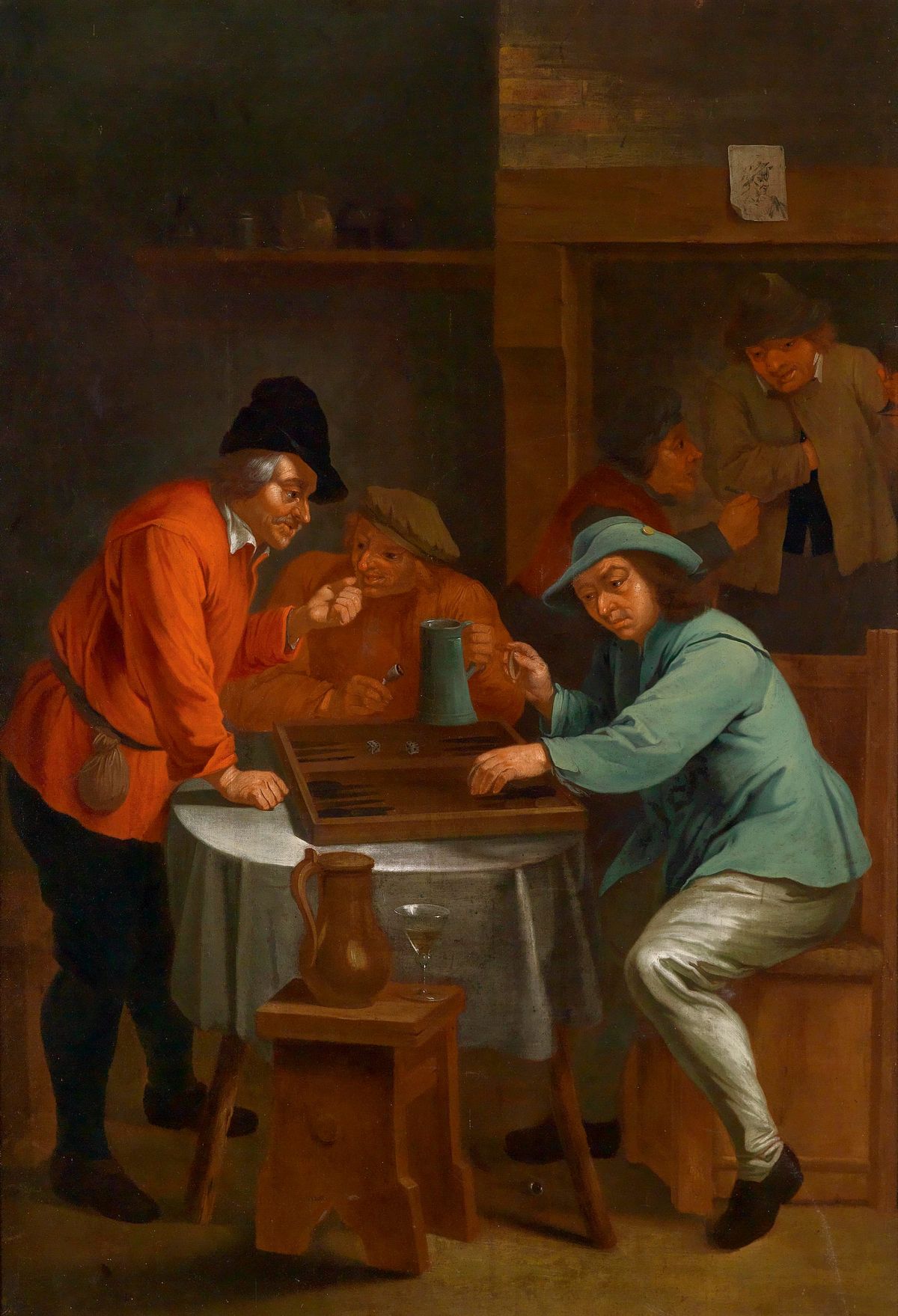
17세기 플랑드르 바로크 풍속화 및 선술집 실내 풍경의 거장 소 다비드 테니어르스(David Teniers le Jeune, 1610–1690)가 1640년대 초중반에 제작한 기념비적 소형 캐비닛 유화 백개먼 게임을 하는 농부들(Backgammon Players, 또는 트릭트랙 게임을 하는 사람들, 네덜란드어: Trictrac-spelers, 공식 소장품 등록번호: NG242)은 37.5 cm × 56.7 cm 크기의 가로형 오크 목판(Oil on wood)에 유채로 그린 대표적인 북유럽 풍속화 최고 걸작입니다.
1854년 콜본 경(Lord Colborne)의 유서 깊은 기증을 통해 영국 런던의 세계적인 내셔널 갤러리(National Gallery, London)에 영구 소장되어 보존되어 오고 있습니다.
17세기 선술집의 인기 보드게임과 도박의 풍속을 향한 화가의 고뇌
1640년대 안트베르펜에서 활동하던 테니어르스는, 당대 플랑드르 선술집에서 가장 대중적인 오락이자 도박이었던 백개먼(네덜란드어로는 트리크트랙, Trictrac) 게임을 벌이는 농민들의 생생한 모습을 화폭에 담고자 깊이 몰두했습니다.
화가는 단순한 여가 선용을 넘어, 주사위의 눈에 일희일비하며 판돈을 걸고 신경전을 벌이는 사내들의 팽팽한 긴장감과, 그 주변에서 참견하며 술잔을 기울이는 이웃들의 왁자지껄한 풍경을 어떻게 은빛 대기(Silvery manner) 속에 해학적으로 녹여낼지 치열하게 번민했습니다.
내셔널 갤러리의 공식 소장 도록에 따르면, 이 작품의 중앙 게임판 위에 놓인 하얀 주사위 큐브는 판돈을 두 배로 올리기 위해 사용되는 더블링 다이(Doubling die)로 분석되며, 17세기 선술집 문화 속에서 행해지던 서민들의 오락과 인간 본성의 승부욕을 보여주는 도상학적 핵심 장치로 평가됩니다.
화가는 어두운 선술집 실내에서, 둥근 탁자에 둘러앉아 백개먼 판에 정신을 집중한 사내들과 뒤편에서 이들을 지켜보는 이웃들의 떠들썩한 순간을 화폭에 담았습니다.
화면 오른쪽 전면에는 푸른 모자와 옷을 입은 사내가 의자에 앉아 진지한 표정으로 백개먼 말판을 움직이고 있으며, 그의 왼쪽에서는 붉은 상의를 입은 사내가 허리를 굽힌 채 다음 수를 참견하며 유쾌한 표정을 짓고 있습니다.
화면 왼쪽 전면의 나무 의자 위에는 작은 주전자가 놓인 탁자와 함께 유리잔이 정교한 정물처럼 자리하고 있으며, 화면 뒤쪽 어두운 벽난로 주변에서도 다른 손님들이 모여 이야기를 나누고 있습니다.
화면 상단 벽에 걸린 종이 한 장과 묵직한 목재 벽난로의 어두운 그림자, 그리고 탁자 위 회색 식탁보의 자연스러운 주름은 거친 일상 속에서 소소한 내기로 즐거움을 찾는 민초들의 생생한 활기를 손에 잡힐 듯 웅변합니다.
게임에 집중하는 사내의 손길에서 참견하는 동반자와 배경의 대화로, 시선의 심리적 여정
그림을 마주하는 순간 관람객의 무의식적 시선은 화면 오른쪽에서 푸른 옷을 입고 백개먼 말판 위에 손을 얹은 채 신중하게 수를 고민하는 사내의 진지한 옆모습과 손끝으로 가장 먼저 빨려 들어갑니다.
승부를 결정짓기 위해 몰입하는 사내의 긴장된 표정은 보는 이에게 깊한 시각적 몰입감과 함께 게임의 현장감을 선사합니다.
이어 시선은 탁자 너머로 몸을 기울이며 붉은 옷을 입고 유쾌한 미소를 짓는 사내의 얼굴과 그가 손가락으로 가리키는 게임판 위의 주사위로 자연스럽게 이동합니다.
참견꾼의 익살스러운 표정과 판돈이 오가는 도박판의 흥겨운 분위기를 체감하는 순간, 관람객은 왁자지껄한 선술집의 소음과 맥주 냄새가 감도는 17세기 플랑드르 실내 한복판 속으로 온몸이 빨려 들어가게 됩니다.
마지막으로 시선은 화면 왼쪽 전면의 나무 의자와 주전자를 지나, 벽난로 어둠 속에서 모여 대화를 나누는 뒷사람들의 실루엣과 벽에 걸린 종이 장식으로 멈춥니다.
전면 인물들의 생생한 심리적 교감과 후면 실내의 아늑한 명암 대비가 빚어내는 조화를 마주하며, 관람객은 삶의 애환을 오락으로 달래는 서민들의 진솔한 풍경과 거장 테니어르스의 뛰어난 관찰력을 가슴 깊이 마주하게 됩니다.
17세기 플랑드르 풍속 회화의 정점과 조형미, 미술계의 평가
미술계와 내셔널 갤러리 공식 도록은 백개먼 게임을 하는 농부들을 테니어르스가 소형 목판 위에 인물들의 미세한 표정 변화와 실내 정물의 질감을 가장 완벽한 완성도로 응축해 낸 대표적인 최고봉 마스터피스로 평가합니다.
단순한 오락 장면을 넘어 당대 서민들의 일상적 도박 문화를 해학적 인물 군상 속에 완벽하게 담아냈을 뿐만 아니라, 나무 판자의 결, 식탁보의 부드러운 패브릭 질감, 유리잔의 투명한 반사광, 실내를 감싸는 은은한 대기감을 극도로 섬세한 북유럽 사실주의 유화 기법으로 완벽하게 구현했기 때문입니다.
인간의 소소한 승부욕과 일상의 풍경을 가장 격조 높은 시각 예술로 승화시킨 테니어르스의 이 걸작 화폭은, 오늘날까지도 전 세계 수많은 감상자들에게 깊은 감탄과 잊을 수 없는 시각적 즐거움을 전해주는 불멸의 명작으로 손꼽히고 있습니다.
Backgammon Players
Painted in the early-to-mid 1640s by the master of Flemish Baroque genre and tavern interior painting David Teniers the Younger (1610–1690), Backgammon Players (Dutch: Trictrac-spelers, Accession No. NG242) is an exquisite cabinet genre masterpiece in oil on oak panel measuring 37.5 cm × 56.7 cm (14.8 in × 22.3 in).
Bequeathed in 1854 by Lord Colborne, it is preserved today in the distinguished permanent collection of the National Gallery in London, United Kingdom.
Tavern Board Games, Trictrac Culture, and Human Competition
During the 1640s in Antwerp, David Teniers the Younger frequently explored the popular tavern recreations of his day, capturing the widespread passion for backgammon—known locally as trictrac—which served as both a favorite pastime and a frequent vehicle for petty gambling among the rural populace.
Moving beyond mere genre illustration, the master meditated deeply on how to portray the intense concentration, friendly rivalry, and animated banter of card and board players gathered in dim alehouses, unified beneath his signature silvery atmospheric light.
According to curatorial records in the National Gallery collection catalogue, the white cube resting in the center of the board is likely a doubling die used to escalate the stakes, serving as a clever iconographic detail that highlights the competitive spirit and gaming habits of 17th-century Flemish society.
Teniers staged the intimate interior scene within the rustic confines of a dimly lit tavern.
In the right foreground, a man wearing a blue hat and jacket sits intently at a round table covered with a grey cloth, moving a piece across the wooden backgammon board.
Leaning over the table behind him, a companion in a red doublet gestures with an amused expression, eagerly commenting on the progress of the game.
In the lower-left foreground, a humble wooden stool supports a ceramic pitcher and a clear glass, while in the shadowed fireplace recess in the background, other patrons gather to converse, completing a vivid slice of everyday tavern life.
Subconscious Trajectory of the Gaze: From the Focused Player to the Joking Companion and Tavern Interior
The observer's subconscious gaze is immediately magnetized by the right foreground, drawn to the concentrated expression and deliberate hand movement of the blue-clad player managing the backgammon pieces.
His furrowed brow, engaged posture, and intense focus establish an instant focal point of narrative tension, human psychology, and dramatic interaction.
The visual path then shifts toward the center, following the leaning figure in red whose smiling face and animated gesture introduce an element of lighthearted humor and social camaraderie.
Taking in the rich details of the game board and the informal atmosphere, the viewer directly experiences the lively sounds, clinking glassware, and smoky air of a 17th-century Flemish tavern room.
Finally, the visual trajectory moves toward the rustic stool and jug on the left, before lifting into the shadowed depths of the background fireplace where distant patrons converse quietly.
Observing the harmonious equilibrium between foreground character study, masterful interior staging, and precise Netherlandish draftsmanship, the spectator perceives the timeless poetry of ordinary leisure and the profound aesthetic brilliance Teniers embedded within the wood panel.
The Monument of Flemish Tavern Genre: Critical Legacy
Art historians revere the National Gallery Backgammon Players as an exceptional achievement in Teniers’s oeuvre, illustrating his consummate ability to unite intimate genre characterization with virtuosic still-life painting on an engaging cabinet scale.
By orchestrating delicate textural contrasts between smooth wood grain, porous ceramic, gleaming glass highlights, and shifting indoor light within a unified tonal space, Teniers transformed a simple tavern game into an exquisite aesthetic treatise on human nature and social interaction.
This precious historical panel endures as an inspiring testament to the master's creative fortitude, celebrating the quiet poetry of everyday existence and the transformative grace of living art.
본 컨텐트의 저작권은 팔렛트제주에 있습니다. 허가없는 무단전제를 금지합니다.
Copyright © Palette Jeju. All rights reserved. Unauthorized reproduction or redistribution is strictly prohibited.