바닷가에서 이야기 나누는 두 여인, 세인트토머스 (Deux femmes causant au bord de la mer, Saint Thomas, 1856)
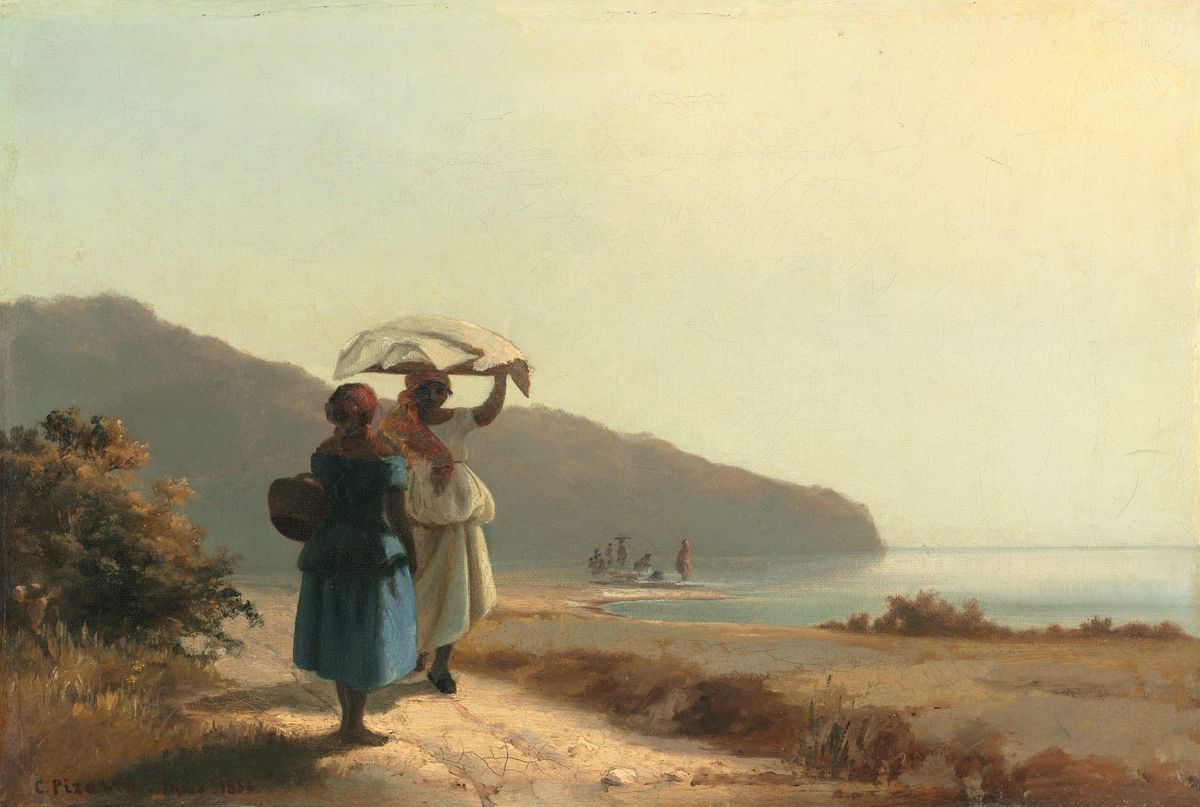
카미유 피사로가 고향인 카리브해의 세인트토머스 섬을 영구히 떠나 파리에 도착한 직후 완성한 이 작품은, 청년 피사로의 기억 속에 각인된 열대의 눈부신 태양광과 고향 사람들에 대한 애정 어린 시선을 고스란히 담아낸 초기 기념비적 역작입니다.
당시 상인의 길을 걷길 바랐던 부모님의 뜻을 뒤로하고 화가의 길을 걷기 위해 프랑스로 건너온 피사로는, 파리의 아틀리에에서 고향에서 직접 사생했던 드로잉들을 바탕으로 카리브해 특유의 작열하는 자연광을 캔버스 위에 재구성했습니다. 가로 41cm, 세로 27.9cm 크기의 캔버스에 유채로 완성된 이 귀중한 초기 명작은, 훗날 인상주의 혁명을 이끌게 될 거장의 빛에 대한 탁월한 감각과 인간 존엄을 향한 따스한 휴머니즘이 이미 청년기에 확고하게 자리 잡고 있었음을 웅변합니다.
관람자의 시각 인지 체계는 화면 좌측 중앙에서 머리에 커다란 보따리를 이고 하얀 드레스를 입은 여인과, 그 곁에서 푸른 원피스를 입고 바구니를 든 여인의 묵직한 형태감에 가장 먼저 도달합니다. 인물들이 입은 선명한 푸른색과 순백의 옷감이 따스한 흙빛 해변과 자아내는 강렬한 명암 대비는 시각 피질의 중심와를 즉각 포획하며 화면의 조형적 구심점을 확립합니다.
이어서 시선은 두 여인의 다정한 몸짓을 스쳐 이들이 걸어가는 완만한 모랫길을 따라 화면 우측으로 부드러운 도약 안구 운동을 진행합니다.
해변 뒤편으로 웅장하게 솟아오른 짙은 갈색 언덕의 완만한 능선을 타고 내려와, 물가에서 일하고 있는 작은 점경 인물들과 은은한 에메랄드빛 바다를 거쳐 캔버스의 절반을 채운 황금빛 대기로 이어지는 시선의 흐름은 2차원의 평면을 아득하고 깊이 있는 3차원 열대 해변의 공간으로 시원하게 확장합니다.
눈부신 햇살이 빚어내는 온화한 대기 질감과 잔잔한 파도 소리가 망막 위에서 하나의 완성된 지각으로 통합되는 순간, 관조자는 복잡한 일상의 긴장을 내려놓고 따스한 바닷바람이 스치는 카리브해의 고요한 해변에 서 있는 듯한 깊은 심리적 안도감과 내면의 평온을 체험하게 됩니다.
이 그림을 그릴 당시 피사로는 카미유 코로와 장 프랑수아 밀레의 자연주의적 태도에 깊은 감명을 받으며 자신만의 독자적인 빛의 조형 언어를 모색하고 있었습니다. 그는 카리브해의 흑인 및 크리올 여성들을 당대의 이국적 취향에 맞춘 관음적 대상이나 단순한 배경으로 다루지 않고, 고된 일상 속에서도 우아함과 자긍심을 잃지 않는 당당한 인간 실존으로 포착했습니다.
완성된 작품 하단에 서명된 초기 서명인 'C. Pizarro'는 당시 그가 품었던 화가로서의 굳은 결의를 상징하며, 훗날 미술사가들은 이 작품을 두고 "피사로가 훗날 인상주의 운동에서 보여줄 인간과 자연의 조화로운 시각적 원형이 이미 완성되어 있던 걸작"이라며 높이 평가했습니다.
작열하는 열대의 태양빛과 그 속에서 살아가는 민중의 소박한 호흡을 단단한 조형미로 담아낸 피사로의 세인트토머스 해변 풍경은, 현대 미술사에서 거장의 예술적 뿌리와 인상주의 태동기의 소중한 빛을 증언하는 독보적인 유산으로 확고하게 평가받고 있습니다.
Two Women Chatting by the Sea, Saint Thomas (Deux femmes causant au bord de la mer, Saint Thomas, 1856)
Painted shortly after Camille Pissarro permanently departed his native Caribbean island of Saint Thomas to settle in Paris, this radiant canvas preserves the master's formative memories of tropical light and the resilient spirit of his homeland.
Defying his family's mercantile expectations to pursue a lifelong vocation in painting, the young artist reconstructed this coastal scene within his Parisian studio, drawing upon on-site sketches executed during his early travels across the West Indies and Venezuela. Measuring 27.9 by 41 cm, this exceptional early oil on canvas demonstrates that the future patriarch of Impressionism already possessed an intuitive mastery of ambient illumination and a profound humanist empathy for ordinary working people.
The observer’s perceptual framework immediately anchors upon the two women engaged in quiet conversation along the left-center path. The vibrant contrast between the rich indigo skirt of the standing figure and the luminous white drapery of her companion carrying a bundle upon her head instantly captures the fovea, establishing an intuitive and balanced narrative core.
From this intimate human juncture, the ocular trajectory glides downward across the warm, sun-baked sand before sweeping along the gentle curve of the shoreline toward the open water on the right.
Ascending along the monumental mass of the coastal hillside, the eye traverses past the minute figures laboring near the gentle surf, dissolving into the vast, luminous horizon where pale gold daylight bathes the tranquil atmosphere in an expansive three-dimensional realm.
As the visual cortex synthesizes these warm earth tones and luminous sea breezes into a cohesive continuum, active visual scanning transitions into profound contemplative stillness, immersing the viewer in the timeless and restorative warmth of the Caribbean coast.
While executing this piece, Pissarro was absorbing the lessons of Camille Corot and Jean-François Millet, forging a direct approach to natural light that avoided salon sentimentalism. Rather than reducing Afro-Caribbean laborers to decorative colonial motifs, he rendered their upright postures and daily rhythms with solemn elegance and uncompromised dignity.
Bearing his early Spanish surname signature, this work remains celebrated across art history as a vital foundational prologue, foretelling the monumental empathy and luminous atmospheric truth that would later define the Impressionist movement.
Masterfully uniting classical spatial balance with the authentic pulse of everyday life, Pissarro's view of Saint Thomas stands as an enduring milestone in the evolution of modern landscape painting.
본 콘텐츠의 저작권은 저작권자에게 있으며, 무단 전재 및 재배포를 금합니다.