앙기아리 전투를 위한 병사의 두상 연구 (Studies of Soldiers' Heads for 'The Battle of Anghiari')
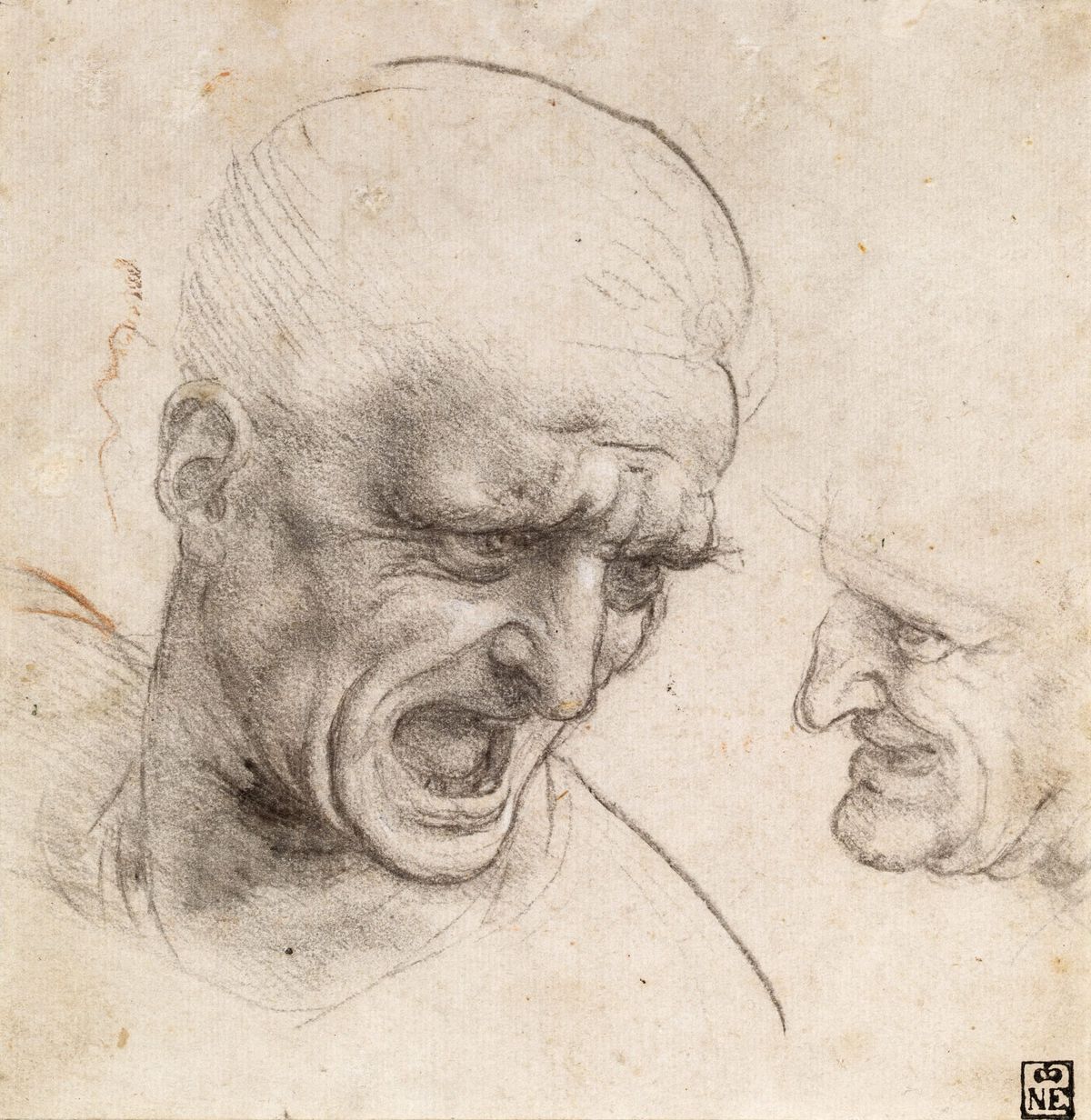
전투의 광기와 인간이 가진 극단의 분노를 화면 위에 고스란히 끌어올린 르네상스 최고 소묘의 정수, <앙기아리 전투를 위한 병사의 두상 연구 (Studies of Soldiers' Heads for 'The Battle of Anghiari')>입니다. 이 작품은 천재 거장 레오나르도 다 빈치(Leonardo da Vinci, 1452–1519)가 1504–1505년경 제작한 희귀 소묘 유작으로, 실제 규격은 가로 18.8cm, 세로 19.1cm 크기이며 현재 헝가리 부다페스트 국립미술관(Museum of Fine Arts, Budapest)에 소장되어 있습니다. 종이 위에 붉은 크레용과 붉은 흑연 필선을 정교하게 겹쳐 사용하여, 전장의 혼란 속에서 포효하는 노병의 분노와 그 옆에 놓인 날카로운 인상의 측면 얼굴을 세밀하게 포착해 낸 드로잉 명작입니다.
화면 중심에 크게 그려진 장수의 얼굴은 전율이 느껴질 만큼 강렬한 표정 묘사를 보여줍니다. 잔뜩 찌푸린 미간과 치켜 올라간 눈썹 주름, 그리고 목의 힘줄이 터질 듯 크게 벌린 입은 전쟁이 불러오는 자발적 광기와 인간 본능의 분노를 적나라하게 보여줍니다. 레오나르도는 인체의 뼈와 근육 구조를 다년간 연구한 해부학적 지식을 바탕으로, 울부짖는 입 주변의 음영과 턱 근육의 긴장감을 섬세한 해칭 기법으로 표현하였습니다. 이는 정적인 고전주의 미학을 넘어 인간의 격렬한 감정 변화를 생체학적 정밀함으로 구현한 르네상스 사실주의의 또 다른 정점이라 할 수 있습니다.
이 소묘는 르네상스 미술사에서 가장 안타깝게 사라진 대형 벽화 프로젝트에 얽힌 흥미진진한 비하인드 스토리를 담고 있습니다. 1503년 피렌체 공화국 정부는 베키오 궁전 대회의장의 벽면을 장식하기 위해 레오나르도에게 피렌체군의 승리를 기리는 <앙기아리 전투> 벽화를 의뢰했습니다. 당시 맞은편 벽면에는 청년 거장 미켈란젤로가 <카시나 전투>를 그리기로 결정되어 있어 당대 최고의 두 천재가 자존심을 걸고 벌인 세기의 대결로 전 유럽의 주목을 받았습니다. 하지만 레오나르도가 시도했던 실험적인 유화 물김 기법이 실패하여 물감이 흘러내리는 바람에 제작이 중단되었고, 이후 다른 벽화로 덮여 실물이 사라지고 말았습니다. 이 때문에 이 작은 종이 위 두상 연구는 두 거장의 세기적 대결과 실전된 대작의 생생한 흔적을 간직한 인류 미술사의 소중한 보물로 높이 평가받고 있습니다.
이 작품을 바라보는 감상자의 심리는 직관적이고 다이내믹한 곡선형 시선 동선을 따라 움직이게 됩니다. 가장 먼저 전율을 부르는 좌측 병사의 크게 벌려진 입과 그 주변의 단단한 턱 근육 묘사에 시선이 강하게 사로잡힙니다. 이어 치켜 올라간 찌푸린 눈썹과 미간의 주름 라인을 따라 오른쪽으로 시선이 이동하면서, 옆에 자리한 매부리코 병사의 정교한 측면 윤곽선과 상호작용하게 됩니다. 이후 매끄러운 이마의 정수리 곡선을 타고 다시 목덜미의 단단한 힘줄 표현을 거쳐 울부짖는 노병의 눈빛으로 시선이 포근하게 회귀합니다. 이러한 시각적 순환 과정은 강렬한 표정이 주는 시각적 충격을 차분하게 흡수하도록 도우며 내면의 명징한 안정을 안겨줍니다.
This masterpiece, titled Studies of Soldiers' Heads for 'The Battle of Anghiari', was created around 1504–1505 by the High Renaissance genius Leonardo da Vinci (1452–1519). Measuring 18.8 cm in width by 19.1 cm in height, this detailed black and red chalk drawing on paper is permanently preserved in the Museum of Fine Arts in Budapest, Hungary. Depicting the terrifying rage of screaming soldiers destined for a monumental battle mural, the sheet stands as a supreme monument of expressive Renaissance draftsmanship.
The main study isolates the face of a veteran soldier roaring in battle, capturing the raw madness and visceral fury of warfare with dramatic realism. Leonardo leveraged his profound understanding of facial anatomy to render the contorted brow, strained neck tendons, and fully opened mouth through fine diagonal hatching. Rather than idealizing the human form, Leonardo utilized precise muscular mechanics to translate raw human emotion into a vivid sculptural presence on paper.
Fascinating historical legends surround this rare preparatory drawing. Commissioned in 1503 by the Florentine Republic to paint The Battle of Anghiari inside the Palazzo Vecchio, Leonardo worked directly opposite his young rival Michelangelo, setting the stage for one of the greatest artistic rivalries in history. Tragic technical failures with Leonardo's experimental oil medium caused the paints to run, leading to the eventual abandonment and loss of the mural. Today, art historians revere this surviving sheet as an invaluable primary document, praising its unmatched psychological intensity and dramatic vigor.
Engaging with this expressive drawing leads the viewer through a dynamic visual path. The eye is initially drawn to the roaring open mouth and tense jaw muscles of the central soldier. The view sweeps upward across his deeply furrowed brow and glides rightward to inspect the sharp aquiline profile of the adjacent head. Tracing the smooth curve of the cranium and the strained neck lines below, the gaze naturally returns to the screaming soldier's eyes, completing a soothing visual loop that resolves emotional tension and induces quiet fascination.
본 리뷰에서 작품을 제외한 컨텐츠의 저작권은 팔렛트제주에 있습니다.
"퍼블릭도메인 고전명화"를 제외한 모든 창작 콘텐츠는 저작권법 제4조 및 제10조에 의거하여 보호됩니다. 무단 도용시 저작권법 제136조(벌칙)에 의거, 당사의 사전 서면 승인 없는 저작권 침해 행위를 금지합니다.