500년 전 캔버스에 박제된 인간의 집단적 광기와 악몽, 쾌락의 정원 The Garden of Earthly Delights
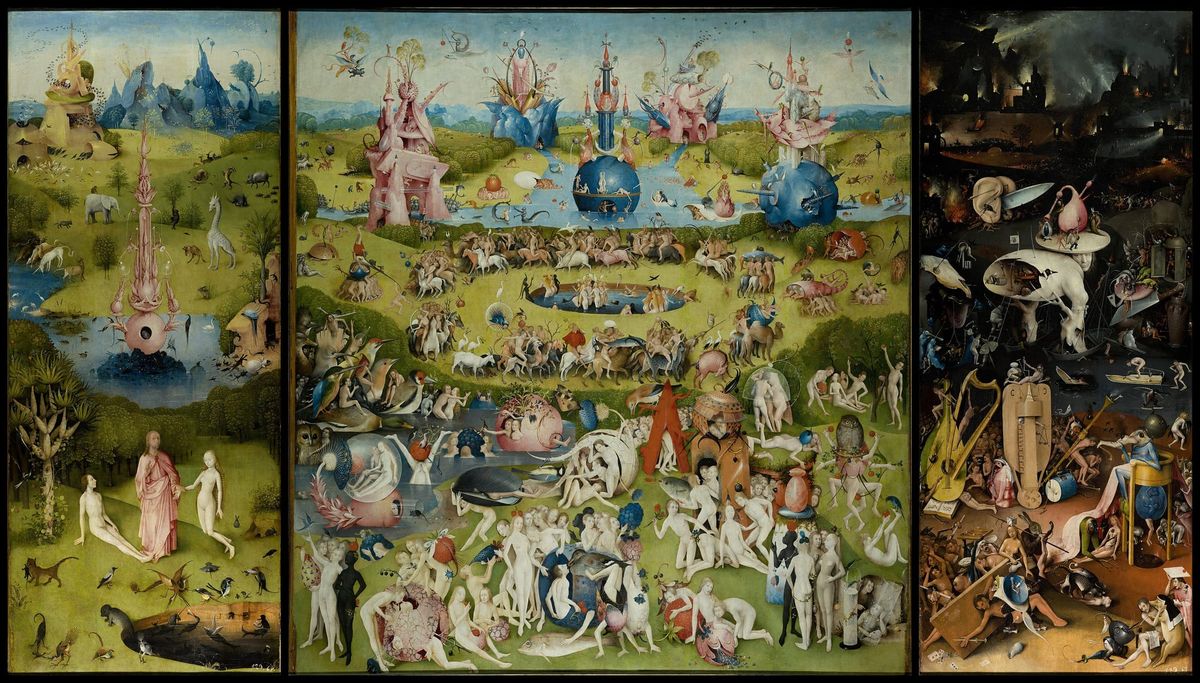
네덜란드 르네상스 시기의 천재적이고 기괴한 거장 히에로니무스 보스(Hieronymus Bosch, c. 1450–1516)가 1490년에서 1510년 사이에 완성한 3연작 제단화(Triptych) 쾌락의 정원(The Garden of Earthly Delights)은 중앙 패널 220.0 cm × 195.0 cm, 양쪽 날개 패널 각각 220.0 cm × 97.0 cm 크기의 참나무 패널에 유채로 그린 대작입니다. 현재 스페인 마드리드의 프라도 미술관(Museo del Prado, Madrid)에 소장되어 있습니다.
천국과 지옥 사이에 놓인 기괴한 환락의 도가니
이 3연작 제단화는 성당 제단에 놓이기 위한 종교화라기보다는 나사우 가문의 귀족을 위한 개인 소장용 작품으로 제작된 것으로 추정됩니다. 왼쪽 패널은 하나님이 아담에게 하와를 소개하는 순결한 에덴동산을, 오른쪽 패널은 죄악에 빠진 인간들이 온갖 기괴한 형벌을 받는 끔찍한 지옥을 묘사합니다. 그리고 이 그림의 중심인 거대한 중앙 패널에는 수백 명의 벌거벗은 남녀가 딸기, 체리 등 육욕을 상징하는 거대한 과일을 탐하고, 거대한 새와 물고기, 환상적인 유리 기구 사이에서 집단적인 환락에 빠져 있는 기묘한 풍경이 펼쳐집니다.
보스는 중세 말기의 도덕적 타락과 쾌락의 덧없음을 경고하기 위해 이 전대미문의 판타지를 창조했습니다. 중앙 패널의 쾌락은 일견 달콤하고 자유로워 보이지만, 달콤한 과일이 금세 썩어 문드러지듯 육체적 쾌락 역시 영원할 수 없음을 폭로합니다. 오른쪽 지옥 패널에서는 악기들이 고문 도구로 변해 하프의 줄에 사람이 묶이고, 악마의 찬송가가 사람의 엉덩이에 오선보로 새겨져 연주되는 등, 20세기 초현실주의를 500년이나 앞선 파격적인 상상력이 극에 달합니다.
기괴한 과일에서 지옥의 불길로, 시선의 심리적 여정
그림을 마주하는 순간 관람객의 무의식적 시선은 중앙 패널 한가운데 자리한 푸른빛의 기괴한 분수대와 그 주위를 맴도는 나체의 무리들로 가장 먼저 진입합니다. 수백 명의 인물들이 얽히고설킨 채 거대한 과일을 베어 물고 환상 속 동물들과 뒤섞여 노니는 비현실적인 광경은 감상자에게 거대한 시각적 호기심과 어지러움을 동시에 안겨줍니다.
이어 시선은 왼쪽의 평화롭고 맑은 에덴동산을 거쳐, 오른쪽 패널의 칠흑 같은 암흑과 불타는 지옥으로 급격하게 곤두박질칩니다. 귀에 칼이 꽂힌 채 인간을 짓밟는 거대한 귀 괴물, 사람을 집어삼킨 뒤 배설하는 새 형상의 악마, 그리고 차가운 얼음물에 빠져 절규하는 죄인들을 확인하는 순간 관람객은 안락한 환상에서 벗어나 잔혹한 현실적 충격과 마주하게 됩니다.
마지막으로 시선은 지옥 패널 한가운데서 공허한 눈빛으로 관람객을 똑바로 응시하는 '나무 인간(Tree-Man)'의 얼굴에 멈춥니다. 몸통이 깨진 알껍데기로 이루어지고 다리가 썩은 나무 기둥인 이 기괴한 존재는 화가 보스 자신의 자화상으로 해석되며, 관람객에게 쾌락의 끝에 기다리는 영혼의 파멸을 서늘하게 경고합니다.
초현실주의를 500년 앞서간 상상력의 정점, 미술계의 평가
미술계는 쾌락의 정원을 서양 미술사에서 인간의 무의식과 악몽, 금기된 욕망을 가장 정교하고 방대하게 시각화한 불멸의 걸작으로 평가합니다.
르네상스 특유의 고전적 이상주의에 얽매이지 않고, 독창적인 상징과 디테일로 가득 찬 독자적 시각 세계를 구축했기 때문입니다. 인간 내면의 광기와 욕망의 이중성을 해부한 보스의 독보적인 회화 세계는 살바도르 달리, 르네 마그리트 등 20세기 초현실주의 거장들에게 절대적인 영감의 원천이 되었습니다.
The Pre-Surrealist Masterpiece of Human Folly, The Garden of Earthly Delights
Painted between 1490 and 1510 by the Early Netherlandish master Hieronymus Bosch (c. 1450–1516), The Garden of Earthly Delights is an oil on oak triptych comprising a central panel measuring 220.0 cm × 195.0 cm (86.6 in × 76.8 in) and two flanking wings measuring 220.0 cm × 97.0 cm (86.6 in × 38.2 in) each, preserved in the permanent collection of the Museo del Prado in Madrid, Spain.
A Moralizing Vision Between Paradise and Damnation
Far from a conventional ecclesiastical altarpiece, this monumental triptych was likely commissioned for the secular palace of the Engelbrecht II of Nassau. The left wing portrays the purity of the Garden of Eden as God introduces Eve to Adam. The right wing plunges into a nocturnal Musical Hell, depicting horrifying torments inflicted upon the damned. The sprawling central panel displays hundreds of nude figures indulging in carnal abandon, frolicking alongside colossal birds, and gorging on oversized strawberries and cherries—traditional medieval symbols of fleeting sensual pleasure.
Bosch crafted this extraordinary psychological landscape as a profound moral allegory on the transience of sinful indulgence. The hedonistic paradise is an ephemeral illusion destined for rot. In the Hell panel, Bosch’s inventive genius reaches its zenith: musical instruments morph into instruments of torture, sinners are crucified on lutes, and blasphemous musical scores are inscribed across human flesh—anticipating 20th-century Surrealism by half a millennium.
Subconscious Trajectory of the Gaze and the Descent into Hell
The observer's subconscious gaze is initially arrested by the fantastical blue fountain in the middle ground of the central panel, encircled by a rhythmic cavalcade of riders mounted upon exotic beasts. The sheer density of bizarre hybrid creatures and naked figures triggers instant sensory overload and fascination.
The visual trajectory then shifts toward the peaceful pastoral serenity of Eden on the left, before plunging precipitously into the apocalyptic firestorms and pitch-black despair of the right wing. Confronted with the grotesque 'Knife-Ear' hybrid slicing through soldiers and the enthroned bird-monster defecating consumed souls into an abyss, the viewer experiences a profound psychological jolt.
Finally, the gaze settles upon the melancholic, enigmatic face of the 'Tree-Man' at the heart of Hell. Widely interpreted as Bosch's own introspective self-portrait amidst his hollowed-out, cracked eggshell body, the figure stares directly at the viewer, transforming the canvas from a medieval spectacle into a timeless existential interrogation of human frailty.
The Pinnacle of Visual Invention: Critical Legacy
Art historians recognize The Garden of Earthly Delights as one of the most enigmatic and visually sophisticated achievements in Western art.
By externalizing the deepest anxieties, collective nightmares, and taboo desires of the medieval psyche, Bosch transcended the illustrative conventions of his era. His unparalleled iconography of hybrid monstrosities and moral satire established an enduring artistic vocabulary that directly catalyzed Modern Surrealism, continuing to captivate scholars and viewers worldwide.
본 컨텐트의 저작권은 팔렛트제주에 있습니다. 허가없는 무단전제를 금지합니다.
Copyright © Palette Jeju. All rights reserved. Unauthorized reproduction or redistribution is strictly prohibited.