3월의 햇살, 퐁투아즈 (Soleil de mars, Pontoise, 1875)
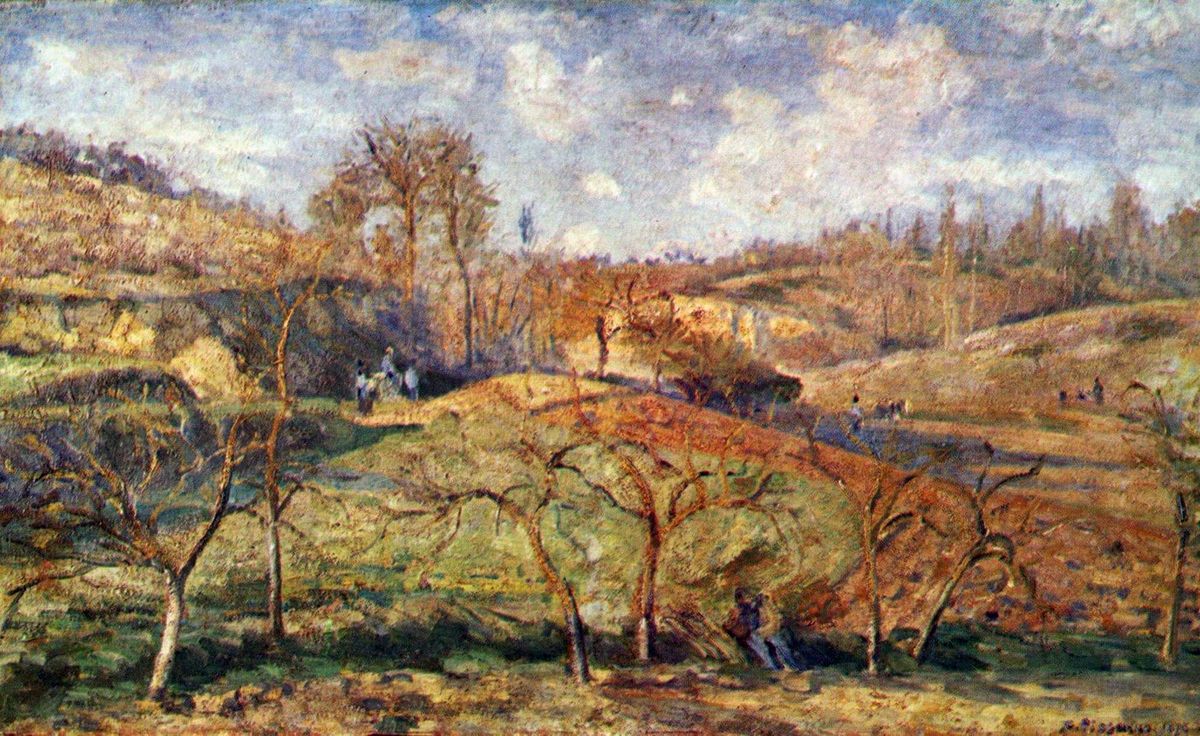
1875년 초봄 퐁투아즈에 머물던 카미유 피사로는 기나긴 겨울의 침묵을 깨고 대지 위로 서서히 번져가는 3월의 은은하고 따스한 햇살을 화폭에 담아냈습니다.
당시 경제적 곤궁과 보수적인 화단의 냉대 속에서도 야외 사생에 대한 확고한 신념을 지켜나가던 그는, 초목이 본격적으로 푸른 잎을 틔우기 직전 대지가 품고 있는 원초적인 흙빛과 대기의 투명한 빛을 세밀하게 관찰했습니다. 가로 72.3cm, 세로 55.3cm 크기의 캔버스에 유채로 완성된 이 작품은 촉각적인 임파스토 기법과 섬세한 색채 분할을 바탕으로, 계절이 교차하는 환절기의 미묘한 공기감을 탁월한 조형적 균형감으로 직조해 낸 대표적인 풍경화입니다.
관람자의 시각 인지 체계는 화면 전경에 율동감 있게 배열된 앙상한 과수원 나뭇가지들의 구불구불한 선율과 흙빛 토양의 짙은 음영에 가장 먼저 정초합니다. 겨울을 견뎌낸 나뭇가지의 날카로운 실루엣과 바닥의 따스한 황토색 질감이 형성하는 조형적 대비는 시각 피질의 중심와를 즉각 포획하며 화면의 탄탄한 전경 기반을 확립합니다.
이어서 시선은 전경 중앙 하단에서 몸을 웅크린 채 작업하는 농부들의 작은 점경을 스쳐, 완만한 곡선을 그리며 솟아오른 양지바른 언덕배기의 밝은 황금빛 능선으로 자연스러운 도약 안구 운동을 진행합니다.
언덕 너머 중경에서 말을 타고 지나가는 행인과 일하는 마을 주민들의 작은 실루엣을 지나, 화면 상단에 역동적인 붓질로 흩뿌려진 옅은 푸른 하늘과 은백색 뭉게구름의 대기 속으로 확장되는 시선의 흐름은 2차원의 평면을 높이와 깊이가 호흡하는 웅장한 3차원 전원 공간으로 개방합니다.
새봄을 깨우는 햇살의 온기와 대지의 서늘한 호흡이 망막 위에서 하나의 조화로운 계절감으로 통합되는 순간, 관조자는 번잡한 일상의 긴장을 내려놓고 초봄의 언덕길을 거니는 듯한 생생한 공간적 현장감과 함께 깊은 심리적 안도감과 내면의 평온을 체험하게 됩니다.
이 그림을 그릴 당시 피사로는 퐁투아즈를 찾아온 폴 세잔과 거의 매일 야외 이젤을 나란히 두고 작업하며, 형태의 영속성과 빛의 순간성을 화폭 위에 통합하는 실험에 몰두하고 있었습니다. 피사로는 단순히 봄날의 화사함만을 쫓지 않고, 언덕과 대지의 단단한 구조적 뼈대를 구축한 뒤 그 위에 부서지는 햇살의 입자들을 촘촘한 색채 터치로 쌓아 올렸습니다.
이러한 피사로의 엄격하면서도 서정적인 풍경 구성법은 세잔이 자연의 형태를 기하학적 볼륨으로 파악하여 독자적인 조형 언어를 확립하는 데 결정적인 회화적 디딤돌이 되었습니다.
동시대 진보적 비평가들은 화려한 장식성을 배제하고 계절의 진솔한 숨결을 있는 그대로 기록한 피사로의 캔버스를 향해 "대지의 정직한 피부와 빛의 생명력을 가장 숭고하게 포착한 예술"이라며 찬사를 보냈습니다.
계절의 문턱에서 태동하는 대지의 생명력과 소박한 인간의 삶을 단단한 조형미와 눈부신 빛의 조화로 완성해 낸 피사로의 '3월의 햇살'은, 현대 미술사에서 인상주의 풍경화가 지닌 서정적 깊이와 구조적 완성도를 완벽하게 증명하는 불멸의 걸작으로 확고하게 평가받고 있습니다.
March Sun, Pontoise (Soleil de mars, Pontoise, 1875)
During the early spring of 1875 in Pontoise, Camille Pissarro captured the subtle awakening of the earth beneath the pale, warming rays of the March sun, marking the quiet transition from winter's dormancy.
Unyielding in his devotion to direct open-air observation despite severe financial adversity and harsh academic criticism, the master focused on the raw textures of tilled soil and the crystalline transparency of early spring daylight before the arrival of dense summer foliage. Measuring 55.3 by 72.3 cm, this horizontal oil on canvas achieves a masterful synthesis of rich, tactile impasto and delicate chromatic division, capturing the shifting atmosphere of changing seasons with profound structural integrity.
The observer’s perceptual framework instantly grounds itself upon the calligraphic rhythm of the bare fruit trees branching across the foreground, where dynamic silhouettes contrast against the sunlit earthen ground. This intricate network of bare wood and rich ochre strokes arrests the fovea, establishing a resolute structural threshold for spatial navigation.
From this foreground barrier, the ocular trajectory glides past the small, laboring figures gathered at the base of the slope, ascending toward the sun-drenched crest of the central knoll bathed in warm amber light.
Sweeping past the minute staffage of horsemen and villagers traversing the middle ground, the eye ascends into the dynamic expanse of cloud-swept azure sky, allowing the visual cortex to synthesize these layered, vibrating brushstrokes into a breathing three-dimensional sanctuary.
As the physical presence of the warming earth and the crispness of early spring air integrate into a unified visual rhythm within the observer's mind, active scanning dissolves into profound contemplative stillness, immersed in the restorative cadence of the countryside.
While executing this work, Pissarro was working side by side with Paul Cézanne in Pontoise, passionately exploring how to combine the structural permanence of nature with the ephemeral vibration of ambient light. Rather than pursuing superficial charm, Pissarro built the underlying topography through disciplined, geometric masses before applying shimmering touches of broken color across the slopes.
This rigorous methodology served as a vital catalyst for Cézanne, who frequently credited Pissarro's honest structural vision with shaping his own path toward modern form.
Contemporary avant-garde critics ardently celebrated the master’s unadorned integrity, praising his singular ability to channel the raw vitality of the soil and the quiet nobility of agrarian existence without decorative sentimentality.
Masterfully harmonizing structural weight with radiant atmospheric poetry, Pissarro's panoramic view of the March sun stands celebrated across art history as an enduring pinnacle of mid-career Impressionist landscape art.
본 콘텐츠의 저작권은 저작권자에게 있으며, 무단 전재 및 재배포를 금합니다.